
Your back hurts. It’s been hurting for months, maybe years. You’ve tried stretching, heating pads, and even sleeping on a different mattress, but the pain stays. Worse, it wakes you up at 3 AM. This isn’t just "bad posture" or "growing pains." If you are under 45 and your back gets stiffer when you sit still but feels better when you move, you might be dealing with Ankylosing Spondylitis (AS). It is an autoimmune disease that causes chronic inflammation in your spine and sacroiliac joints. Left unchecked, this inflammation can lead to bone growths that fuse your vertebrae together-a condition known as "bamboo spine." But here is the good news: you can stop that process. With the right mix of medication and specific mobility strategies, most people with AS maintain full independence and quality of life.
Understanding Ankylosing Spondylitis: More Than Just Back Pain
Most people think of back pain as mechanical-something you pulled lifting groceries or slouching at a desk. Mechanical pain usually feels better when you rest. Ankylosing Spondylitis is different. It is inflammatory. The pain worsens with inactivity and improves with exercise. According to the National Institute of Arthritis and Musculoskeletal and Skin Diseases (NIAMS), AS affects about 0.2% to 0.5% of the US population. That means roughly 1 in 200 people has it. Men are diagnosed twice as often as women, though women often face longer delays in getting the correct diagnosis because their symptoms can be more subtle or spread to peripheral joints.
The root cause lies in your immune system attacking healthy tissue, specifically the entheses-the spots where ligaments and tendons attach to bones. Over time, this chronic attack triggers the body to lay down new bone in an attempt to heal. Instead of healing, these bony outgrowths, called syndesmophytes, bridge the gaps between vertebrae. Without intervention, 30-40% of patients may experience significant spinal fusion within 10 to 20 years of symptom onset. The goal of treatment is not just pain relief; it is preserving the architecture of your spine so you can keep moving freely.
Recognizing the Signs: When to See a Rheumatologist
Diagnosis is often delayed. Data from the Spondylitis Association of America shows that nearly 70% of patients wait more than three years to get a proper diagnosis. They see multiple doctors who mistake AS for depression or simple mechanical back strain. You need to know the red flags. Look for the "inflammatory back pain" criteria defined by the Assessment of SpondyloArthritis International Society (ASAS). Do you have at least four of these five features?
- Onset before age 45: Most cases start between ages 17 and 45.
- Insidious onset: The pain creeps up slowly rather than appearing after a specific injury.
- Improvement with exercise: Moving around makes you feel better, while resting makes you stiffer.
- No improvement with rest: Lying down doesn’t help much.
- Night pain: Pain wakes you up in the second half of the night (often between 3 AM and 6 AM).
If this sounds like you, don’t wait. Early diagnosis is critical. A rheumatologist will look for the HLA-B27 gene marker. While having this gene doesn’t guarantee you’ll get AS, 88-96% of Caucasian patients with AS carry it. They will also order imaging. X-rays show changes in the sacroiliac joints, but MRI is now the gold standard for early detection, spotting inflammation before permanent bone damage appears.
Medication Strategies: Controlling the Fire
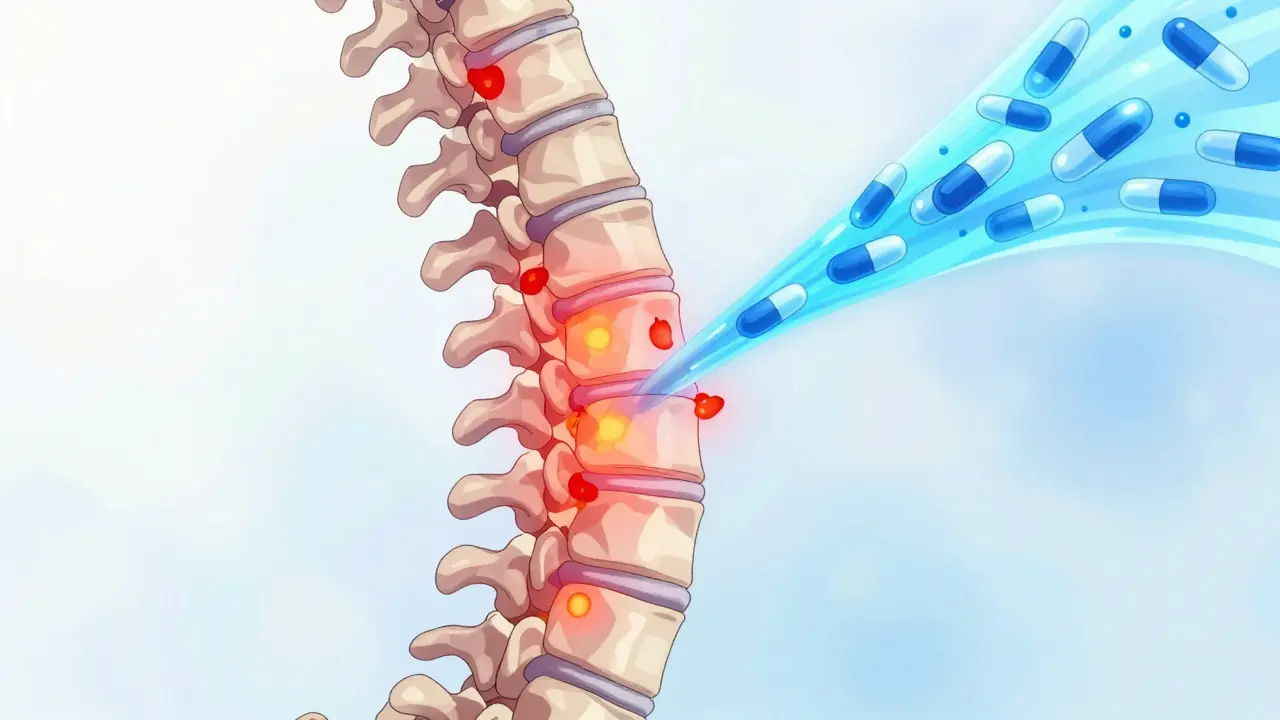
You cannot stretch away active inflammation. Think of medication as putting out the fire so your physical therapy can rebuild the house. The first line of defense is almost always Non-Steroidal Anti-Inflammatory Drugs (NSAIDs). Drugs like naproxen or indomethacin are not just for pain; they reduce the underlying inflammation. Studies cited by the Johns Hopkins Arthritis Center suggest that consistent NSAID use can slow radiographic progression by up to 50% over two years compared to taking them only when pain is unbearable.
If NSAIDs aren’t enough, the next step is biologic therapy. These are targeted drugs that block specific proteins driving the inflammation. TNF inhibitors (like adalimumab or etanercept) have been the standard for years. Newer options include IL-17 inhibitors (like secukinumab) and JAK inhibitors (like upadacitinib, approved by the FDA in 2023). Clinical trials show that 40-60% of patients achieve significant improvement (ASAS40 response) within 12 weeks of starting biologics. While the cost is high-often thousands per month without insurance-these drugs prevent the structural damage that leads to disability. Don’t skip doses. Consistency is key to keeping the inflammation suppressed.
Mobility Strategies: Exercises That Actually Work
Medication stops the damage; movement preserves function. Dr. Muhammad Asim Khan from Johns Hopkins notes that structured exercise programs improve spinal mobility by 25-30% over six months. But not all exercise is created equal. You need movements that promote extension (arching backward) and opening up the chest, counteracting the natural tendency to hunch forward.
| Exercise Type | Goal | Frequency & Duration |
|---|---|---|
| Deep Breathing | Expand rib cage and prevent chest wall fusion | 10 minutes, 2x daily. Stand tall, inhale deeply through nose, exhale slowly. |
| Spinal Extensions | Counteract kyphosis (forward hunch) | 10 reps, 2x daily. Lie on stomach, prop up on elbows, gently arch back. |
| Aquatic Therapy | Low-impact strengthening and range of motion | 30-45 minutes, 3x weekly. Warm water reduces stiffness significantly. |
| Posture Checks | Maintain neutral spine during daily activities | Continuous. Set hourly reminders to reset shoulders back and chin level. |
Start small. If morning stiffness locks you up, do gentle movements in bed before getting up. Heat therapy for 20 minutes before exercising can make a huge difference. Many patients find swimming particularly effective because the buoyancy supports the joints while allowing full range of motion. One patient reported reducing morning stiffness from 90 minutes to 20 minutes just by swimming 45 minutes daily. Consistency beats intensity. Doing 15 minutes every day is better than an hour once a week.

Lifestyle Adjustments: Sleep, Work, and Stress
Your environment matters. Sleeping on a soft mattress encourages curling up, which promotes spinal curvature. Switch to a firm mattress and try sleeping on your back with a thin pillow or no pillow at all to keep your neck aligned. At work, ergonomic adjustments are non-negotiable. Use a lumbar support cushion, raise your monitor to eye level, and take breaks every 30 minutes to stand and stretch. The National Health Interview Survey found that 42% of AS patients require workplace accommodations to stay productive. Ask for them. Fatigue is a major symptom, affecting 74% of patients, so pacing yourself is crucial. Listen to your body-if you’re tired, rest, but don’t become sedentary.
Stress management is also part of the puzzle. While stress doesn’t cause AS, it can trigger flares. Mindfulness, yoga (specifically AS-adapted styles), and adequate sleep help regulate the immune system. Remember, this is a marathon, not a sprint. Some days will be harder than others. On flare days, stick to gentle range-of-motion exercises rather than intense workouts. The goal is to keep the joints lubricated and mobile, not to push through pain.
Living with AS: Long-Term Outlook
Decades ago, AS was a one-way ticket to disability. Today, thanks to better diagnostics and powerful medications, the outlook is vastly improved. Data from the Outcome in Ankylosing Spondylitis International Study (OASIS) cohort shows that 75% of patients maintain functional independence 20 years after diagnosis. That is a massive shift. The key is early action. Don’t ignore persistent back pain. Get tested. Start treating. Move daily. You have more control over this disease than you might think.
Can Ankylosing Spondylitis be cured?
No, there is currently no cure for Ankylosing Spondylitis. However, it can be effectively managed. With proper medication and lifestyle changes, many people achieve remission where they have little to no symptoms and prevent structural damage to the spine.
What is the best exercise for AS?
The best exercises focus on spinal extension and chest expansion. Swimming, deep breathing exercises, and yoga are highly recommended. Avoid high-impact activities that jar the spine, such as running on hard surfaces, especially during flare-ups.
Does diet affect Ankylosing Spondylitis?
While no specific diet cures AS, an anti-inflammatory diet rich in omega-3 fatty acids, fruits, vegetables, and whole grains may help reduce systemic inflammation. Some patients report benefits from reducing processed foods and sugar, though individual responses vary.
How long does it take to diagnose AS?
Unfortunately, diagnosis is often delayed. Surveys indicate that many patients wait 3 to 5 years to receive an accurate diagnosis. To speed this up, seek a rheumatologist if you have inflammatory back pain starting before age 45, and request HLA-B27 testing and MRI imaging.
Is Ankylosing Spondylitis genetic?
Yes, genetics play a strong role. The HLA-B27 gene is present in up to 96% of Caucasian patients with AS. However, having the gene does not mean you will definitely develop the disease, and some people with AS do not have the gene. Environmental factors likely trigger the onset in genetically susceptible individuals.