
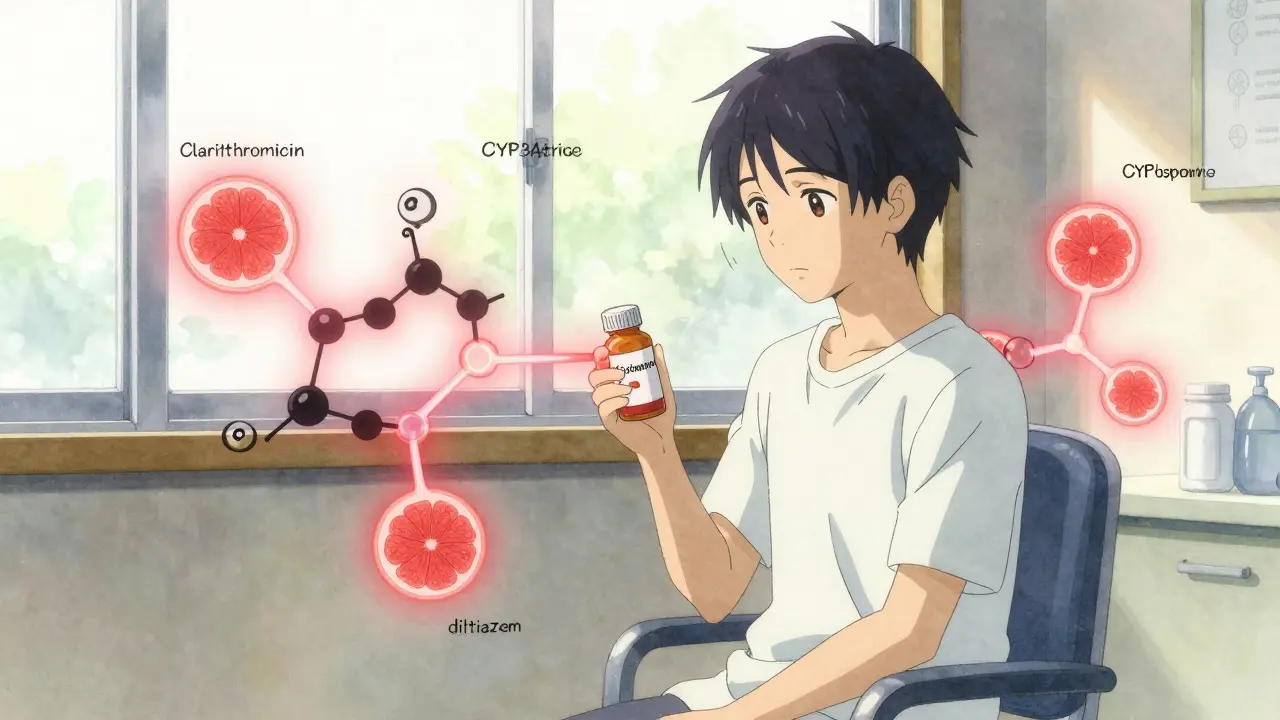
Cyclosporine Drug Interaction Checker
Check Your Medication Safety
Cyclosporine inhibits CYP3A4 enzyme, affecting 60% of all drugs. Enter a medication to see interaction risk.
Note: This tool provides general information. Always consult your doctor or pharmacist before changing medications.
When you take cyclosporine, you're not just managing your immune system-you're navigating a minefield of drug interactions. This isn't theoretical. It's daily reality for transplant patients, rheumatoid arthritis sufferers, and others on long-term immunosuppression. The problem? Cyclosporine doesn't just get broken down by your liver-it actively blocks a key enzyme called CYP3A4, which handles nearly 60% of all prescription drugs. That means anything you take alongside it-antibiotics, blood pressure pills, even some herbal supplements-can suddenly become too powerful, or too weak, with dangerous results.
What CYP3A4 Does (And Why It Matters)
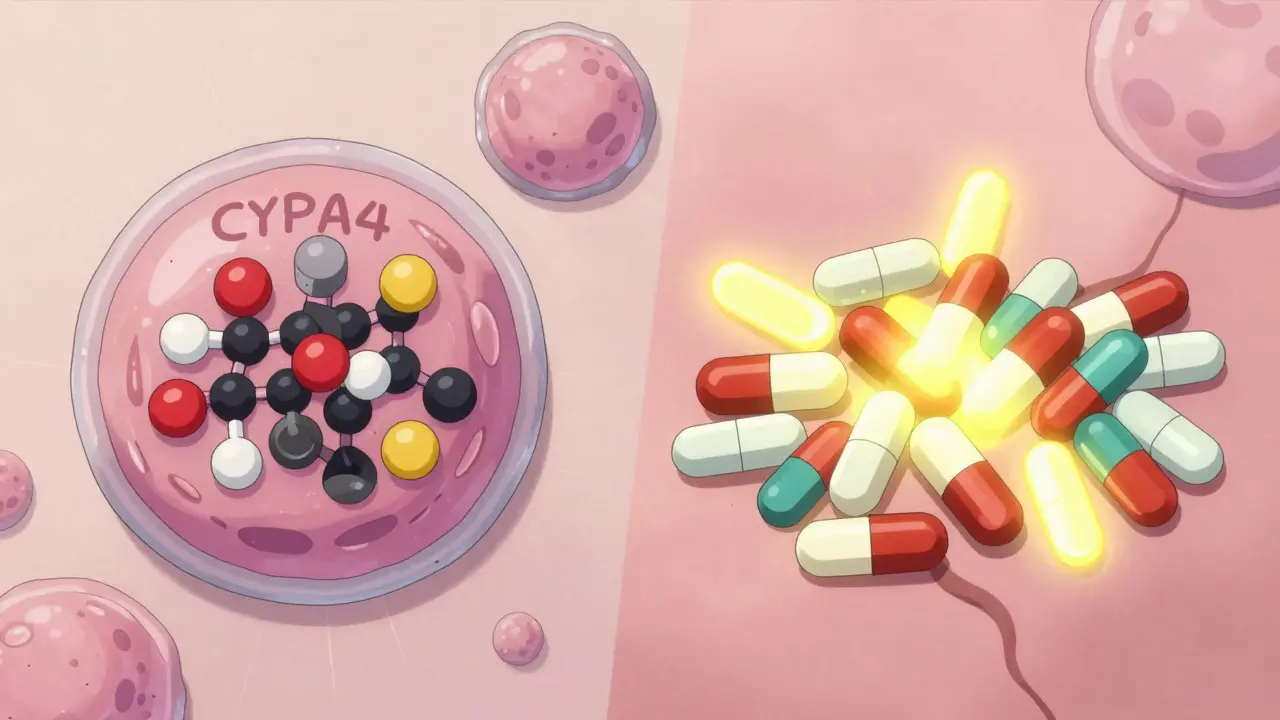
CYP3A4 is the most common enzyme in your liver and gut. Think of it like a factory worker who chops up drugs so your body can get rid of them. About 60% of all medications you take-statins, antifungals, calcium channel blockers, some cancer drugs-go through this factory. When CYP3A4 is working normally, it keeps drug levels in a safe range. But if something blocks it, those drugs pile up. And if CYP3A4 gets overstimulated, drugs vanish too fast.
Cyclosporine is unusual because it doesn’t just get processed by CYP3A4-it shuts it down. That’s not just a side effect. It’s a core part of how the drug behaves. And that’s why even small changes in your medication list can trigger serious problems.
How Cyclosporine Blocks CYP3A4
Not all inhibitors work the same way. Some, like grapefruit juice or clarithromycin, jam the enzyme’s active site like a stick in a gear. Cyclosporine does something more complex. Studies show it acts as a mixed inhibitor-meaning it both competes with other drugs for the enzyme’s attention and slowly damages the enzyme itself over time. This is called mechanism-based inhibition. It’s not a quick fix. It builds up. The more you take cyclosporine, the more CYP3A4 gets worn down.
This isn’t just theory. In lab tests, cyclosporine reduced CYP3A4 activity by up to 70% in some patients. And it doesn’t stop at CYP3A4. It also blocks P-glycoprotein, a transporter that moves drugs out of cells. So you’ve got two systems being disrupted at once. That’s why interactions with cyclosporine are often worse than with other drugs.
Drugs That Can Turn Dangerous With Cyclosporine
Here’s what happens when cyclosporine teams up with common medications:
- Sirolimus: Used after transplants. When taken with cyclosporine, sirolimus levels jump by over 200%. That’s why doctors cut sirolimus doses by 70% when both are used.
- Diltiazem and verapamil: Blood pressure drugs. These are moderate CYP3A4 inhibitors. When added to cyclosporine, the risk of kidney damage and high blood pressure spikes. Doses of cyclosporine often need to be lowered by 25-50%.
- Clarithromycin: An antibiotic. This one’s dangerous. One study found kidney transplant patients saw their creatinine levels rise 40-60% within 72 hours of starting clarithromycin. That’s acute kidney injury in the making.
- Statins (like simvastatin or atorvastatin): Used for cholesterol. Cyclosporine can make these drugs 5-10 times more potent. That raises the risk of muscle breakdown (rhabdomyolysis)-a life-threatening condition.
- Rifampin: An antibiotic and tuberculosis drug. This one does the opposite. It induces CYP3A4, meaning it speeds up cyclosporine breakdown. Trough levels can crash by 50-80%. That’s not just a drop-it’s rejection territory.
Even over-the-counter stuff like St. John’s Wort can cause problems. It’s a known CYP3A4 inducer. One patient on cyclosporine for lupus saw her levels drop so low she had a kidney rejection episode within weeks of starting the herb.
Why Tacrolimus Is Different
You might hear doctors compare cyclosporine and tacrolimus. They’re both calcineurin inhibitors. But they’re not the same. Tacrolimus is mostly a substrate of CYP3A4-it gets broken down by the enzyme. It doesn’t shut it down. So if you take a CYP3A4 inhibitor like ketoconazole with tacrolimus, tacrolimus levels skyrocket. But if you take cyclosporine with the same drug, cyclosporine pushes the levels of the other drug up.
This difference changes everything. A patient switched from cyclosporine to tacrolimus because they were having too many interactions. But then they got prescribed a new antifungal. Their tacrolimus level jumped 300%. They ended up in the hospital with tremors and kidney failure. Cyclosporine might cause more interactions overall, but tacrolimus is more vulnerable to outside drugs. Neither is easy.
Genetics Play a Role-And So Does Your Liver
Not everyone processes cyclosporine the same. Some people have genetic variants of CYP3A4 that make the enzyme work slower. Studies show certain variants reduce enzyme efficiency by up to 40%. That means two people on the same dose of cyclosporine can have wildly different blood levels. One might be perfectly safe. The other could be at risk of kidney damage or high blood pressure.
And it’s not just genes. Your liver health matters. If you have cirrhosis, hepatitis, or even long-term alcohol use, CYP3A4 activity drops. That means cyclosporine and other drugs stick around longer. One 2021 study found transplant patients with fatty liver disease had 35% higher cyclosporine levels than those without, even on the same dose.

What Doctors Actually Do to Stay Safe
Transplant centers don’t leave this to chance. Here’s what real-world protocols look like:
- Therapeutic Drug Monitoring (TDM): Blood tests to check cyclosporine levels. Target range? Usually 100-400 ng/mL, depending on the transplant type and time since surgery. Too low? Rejection risk. Too high? Kidney damage.
- Baseline before changes: Before starting a new drug, doctors check your cyclosporine level. Then they check again 3-7 days later. If it jumps 30% or more, they adjust.
- Dose reductions: When adding a moderate CYP3A4 inhibitor (like diltiazem), reduce cyclosporine by 25-50%. With strong ones (like clarithromycin), cut it by 50-75%.
- Alternative drugs: If you need an antibiotic, azithromycin is often chosen over clarithromycin because it doesn’t inhibit CYP3A4. For statins, pravastatin or rosuvastatin are safer-they don’t rely on CYP3A4.
- Electronic alerts: Hospitals now use systems that flag interactions before a prescription is filled. One 2022 study showed this cut adverse events by 45% across 12 transplant centers.
Pharmacists spend months training just to master these rules. And even then, mistakes happen. A 2023 review found that 32.7% of kidney transplant patients had at least one significant drug interaction in their first year. Over 8% needed hospitalization.
What You Can Do
You’re not powerless. Here’s how to protect yourself:
- Keep a full list: Every pill, supplement, and OTC drug you take. Include vitamins, herbal teas, and pain relievers. Bring it to every appointment.
- Ask before starting anything: Even if it’s “just” melatonin or turmeric. Many patients don’t realize supplements can be dangerous.
- Know your numbers: Ask your doctor what your last cyclosporine level was. If you don’t know, you can’t tell if something’s off.
- Watch for signs: Swelling, fatigue, dark urine, muscle pain, or unusual dizziness could mean toxicity. Don’t wait for your next appointment.
- Use one pharmacy: This helps them track interactions across all your meds.
There’s no perfect solution. But awareness saves lives. The FDA says cyclosporine is a CYP3A4 inhibitor. That’s not a footnote-it’s a warning label on every prescription.
What’s Next?
Researchers are building tools to predict your risk before you even take a pill. New algorithms use your genetics, liver function, current meds, and even your diet to estimate how cyclosporine will behave in your body. Early versions are 85-90% accurate. Point-of-care blood tests are coming too-devices that give you your cyclosporine level in minutes, not days.
But for now, the best tool is still knowledge. And vigilance. Because when cyclosporine and CYP3A4 collide, there’s no middle ground. Either you’re safe-or you’re in danger.
Can I take grapefruit juice with cyclosporine?
No. Grapefruit juice is a strong CYP3A4 inhibitor. Even a single glass can raise cyclosporine levels by 30-50%. This increases the risk of kidney damage and high blood pressure. Avoid it completely while on cyclosporine.
Does cyclosporine interact with birth control pills?
Yes. Cyclosporine can increase levels of estrogen and progestin in birth control pills, raising the risk of blood clots, high blood pressure, and liver issues. Hormonal contraceptives are not recommended for patients on cyclosporine. Talk to your doctor about non-hormonal options.
Why do I need blood tests if I feel fine?
Cyclosporine toxicity doesn’t always cause symptoms until it’s too late. You might feel fine but have kidney damage or dangerously high levels. Blood tests catch problems before they cause harm. Most transplant centers check levels weekly at first, then every 1-3 months once stable.
Is cyclosporine still used today, or have newer drugs replaced it?
Tacrolimus is now the first choice for most transplants because it’s more effective and has fewer interactions. But cyclosporine is still widely used-especially in children, patients with autoimmune diseases like psoriasis, and those who can’t tolerate tacrolimus. It’s not outdated-it’s just used differently now.
Can I stop taking cyclosporine if I have side effects?
Never stop cyclosporine without your doctor’s direction. Stopping suddenly can cause organ rejection, which can be fatal. If you have side effects, tell your doctor. They can adjust your dose, switch medications, or treat the side effect-without risking your transplant.





9 Comments
this post saved my life honestly
my mom's on cyclosporine after her kidney transplant and we had no idea about the grapefruit thing until we read this
we stopped it cold and her numbers went back to normal in a week
thank you for writing this like a real person not a textbook
you're all being way too nice. this isn't 'awareness'-this is a pharmaceutical trap. they *want* you dependent on blood tests and constant dose tweaks. why? because it makes you a lifelong customer. cyclosporine is basically a money printer for big pharma. and don't get me started on how they market tacrolimus as 'better' when it's just the same drug with a shinier label.
Grapefruit juice? Don't even think about it. Clarithromycin? Avoid like plague. Statins? Switch to pravastatin. Period. This isn't opinion-it's protocol. If you're on cyclosporine, your pharmacist should be your best friend. And if they're not flagging interactions? Find a new one.
i read this at 2am after my doc changed my dose and i was panicking
thank you for making it so clear
also i just found out my local pharmacy has a free interaction checker app
they never told me about it... weird
in india we use cyclosporine more than tacrolimus because cost
many patients cannot afford the newer drugs
but the interactions? same danger
we need more awareness in rural clinics
not just in usa hospitals
EVERYONE IS MISSING THE BIG PICTURE. 🚨
THE FDA KNEW THIS WAS A TROUBLE TIME BOMB. 🕰️
THEY ALLOWED CYCLOSPORINE TO BE MARKETED WITH 'MILD' WARNINGS BECAUSE OF LOBBYING FROM PHARMA GIANTS. 🤫
AND NOW? THEY'RE PUSHING 'PERSONALIZED ALGORITHMS' LIKE A MAGIC SOLUTION. 🤖
IT'S NOT SOLUTION. IT'S CONTROL. THEY WANT YOU TRACKED. MONITORED. DEPENDENT. 💉
THEY'RE SELLING YOU A LIFETIME OF BLOOD TESTS. NOT HEALTH. 💔
WHO IS REALLY PROFITING HERE? 🤔
i've been on this med for 8 years. felt fine until i started taking melatonin for sleep.
turned out it was lowering my levels.
now i take it at night, cyclosporine in morning.
simple fix. but i almost didn't know.
thanks for the reminder to ask.
The CYP3A4-mediated pharmacokinetic interplay is fundamentally non-linear and substrate-dependent, rendering empirical dose adjustments statistically unreliable without therapeutic drug monitoring (TDM) and pharmacogenomic stratification. The article, while clinically relevant, lacks granularity regarding CYP3A5*3 polymorphism prevalence in non-Caucasian populations, which significantly alters metabolic clearance. Furthermore, the concomitant inhibition of P-gp introduces a secondary pharmacodynamic variable that is routinely underappreciated in primary care protocols. One must interrogate the pharmacodynamic architecture-not merely the pharmacokinetic surface.
this is why you never start a new supplement without telling your transplant team
even 'harmless' stuff like turmeric or omega-3s can do damage
you're not being paranoid-you're being smart
keep that list updated
and if your doctor seems rushed? ask for the pharmacist. they're the real heroes here.
Write a comment