
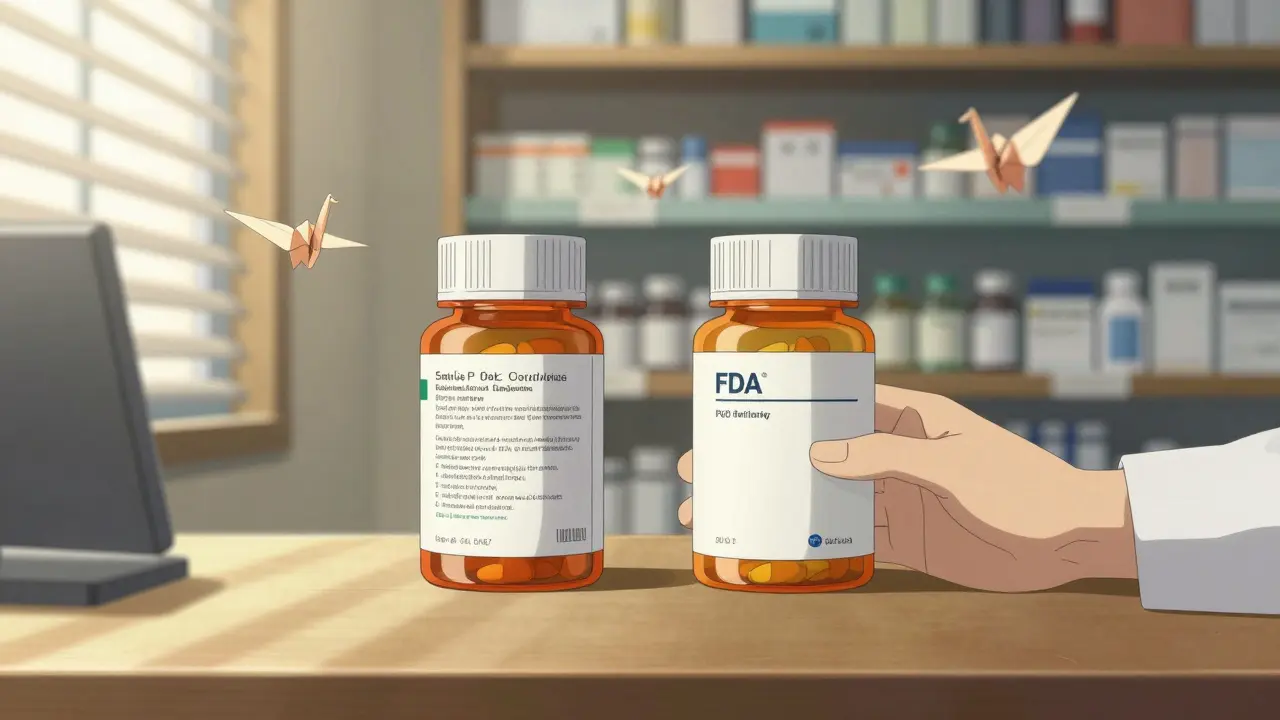
FDA vs EMA Labeling Comparison Tool
Select an aspect from the dropdown to see the comparison.
When a new drug hits the market in the U.S. or the EU, the label you see on the box or in the prescription packet isn’t just a suggestion-it’s a legal document. But here’s the catch: the same drug, approved by both the U.S. Food and Drug Administration (FDA) and the European Medicines Agency (EMA), often comes with two completely different labels. That’s not a mistake. It’s by design.
Why Two Different Labels for the Same Drug?
The FDA and EMA don’t just regulate drugs differently-they think about risk, evidence, and patient communication in fundamentally different ways. The FDA, a centralized U.S. agency, operates under strict federal laws that demand clear, concise, and conservative labeling. The EMA, a network of 27 national regulators across the EU, works under a broader, more flexible legal framework that allows for more nuanced communication. Take pregnancy warnings. For one antidepressant, the FDA label might say: "Avoid use during pregnancy unless benefit justifies risk." Meanwhile, the EMA label for the same drug might read: "Use with caution; available human data suggest low risk." Both are based on the same clinical trial data. But the FDA leans toward caution. The EMA leans toward context. This isn’t about one agency being right and the other wrong. It’s about culture, law, and how each system defines "acceptable risk."Labeling Formats: SmPC vs Prescribing Information
In the EU, the official prescribing document is called the Summary of Product Characteristics (SmPC). In the U.S., it’s the Prescribing Information (PI). Both serve the same purpose: guide doctors on how to use the drug safely. But their structure and tone are worlds apart. The SmPC is dense, detailed, and organized into 16 mandatory sections. It includes everything from pharmacokinetics to post-marketing surveillance plans. It’s written for healthcare professionals, but it’s also the source for patient leaflets translated into 24 EU languages. The FDA’s PI is more streamlined. It’s organized by priority: indications first, then dosing, then warnings. It avoids jargon where possible and prioritizes clarity over completeness. The FDA doesn’t require pharmacokinetic data in the PI unless it directly affects dosing. The result? A doctor in Germany might have a 20-page SmPC in front of them. A doctor in Texas might have a 12-page PI. Both are legally valid. Neither is "more complete." They’re just built for different systems.Who Gets What: Patient-Reported Outcomes
One of the biggest gaps between EMA and FDA labeling is how they handle patient-reported outcomes (PROs). These are claims like "improves fatigue" or "enhances ability to perform daily tasks"-things patients actually feel, not just lab numbers. Between 2006 and 2010, 75 drugs were approved by both agencies. Of those:- 35 (47%) got at least one PRO claim from the EMA
- Only 14 (19%) got one from the FDA
- Just 4 (11%) had identical PRO claims approved
Risk Management: REMS vs RMP
When a drug carries serious risks-like liver damage or birth defects-the agencies don’t just slap on a warning. They enforce systems to manage those risks. The FDA uses Risk Evaluation and Mitigation Strategies (REMS). These are rigid, legally binding programs. For some drugs, REMS require:- Only one distributor to control supply
- Doctors to complete mandatory training
- Patient enrollment in registries

Language and Translation: The Hidden Cost
If you’re a pharmaceutical company submitting a drug to the EMA, you don’t just translate the label once. You translate it 24 times-into every official EU language: French, German, Polish, Croatian, Maltese, you name it. That’s not just a paperwork headache. It’s a financial one. Companies estimate multilingual labeling adds 15-20% to development costs. It delays launch. It increases error risk. One typo in a Polish leaflet could mean a patient misuses the drug. The FDA? Only English. Simple. Fast. Cheap. This difference alone makes it harder for small biotech firms to enter the EU market. Many skip Europe entirely unless the drug has blockbuster potential.Approval Speed and Indications
The EMA approves drugs faster in the first round. About 92% of applications get approved on the first try. The FDA? Only 85%. Why? Because the FDA rejects more applications upfront-not because the drug is unsafe, but because the evidence isn’t strong enough by their standards. In 52% of cases where the two agencies disagreed on whether to approve a drug, the issue wasn’t safety. It was how they interpreted the same clinical data. One agency saw a clear benefit. The other saw inconsistent results. Oncology drugs show this clearest. The EMA often accepts surrogate endpoints-like tumor shrinkage-as proof of benefit. The FDA usually demands proof that the drug extends life or improves quality of life. That’s why a cancer drug might be approved in Europe for metastatic disease but still be under review in the U.S. It’s not that one is wrong. It’s that one values speed. The other values certainty.Orphan Drugs and Exceptional Circumstances
For ultra-rare diseases-think fewer than 5,000 patients in the EU-the EMA has a special pathway called "exceptional circumstances." If you can’t run a full clinical trial because there aren’t enough patients, the EMA may approve the drug based on smaller studies, real-world data, or even animal models. The FDA doesn’t have an exact equivalent. It uses "accelerated approval," but that still requires strong evidence of benefit. There’s no official "we don’t have enough patients, but here’s what we’ve got" route. That means companies developing drugs for ultra-rare conditions must build two separate evidence packages: one for the EMA’s flexibility, one for the FDA’s rigor.





15 Comments
Of course the FDA is paranoid. They’re terrified of lawsuits. Meanwhile, the EMA lets patients decide what’s worth risking - because real people aren’t spreadsheets. The FDA’s labeling is basically legal insurance written in crayon. If your drug makes someone feel less tired, don’t tell them it ‘hasn’t been proven’ - tell them the truth: ‘Some people feel better, some don’t.’ That’s not negligence, that’s honesty.
Let me tell you something - this whole thing is a corporate shell game disguised as regulatory science. The FDA’s ‘rigor’ is just a fancy word for ‘we don’t want to be sued by a widow who read the label wrong.’ The EMA’s flexibility? That’s not weakness - it’s trust in doctors and patients. And don’t get me started on the 24-language headache. You know who pays for that? You. Me. The guy in Poland who misreads the leaflet because the translator used Google Translate. Pharma’s profit margins love this system. Patients? Not so much.
I’ve seen this firsthand - my mom switched from a US prescription to one filled in Germany after we moved. The differences in wording made her panic for weeks. She thought the drug wasn’t working because the US label said ‘no proven benefit for fatigue,’ but the German one said ‘many patients report improved energy.’ It’s not the drug - it’s the language. We need better patient education, not just more legal jargon.
THE FDA ISN’T PARANOID - THEY’RE PROTECTING YOU FROM THE EMA’S EXPERIMENTAL BULLSHIT. You think Europe’s ‘patient-centered’ approach is compassionate? It’s reckless. They approve drugs based on feelings, not data. That’s not healthcare - that’s therapy with a pill. If you want to live in a country where your meds are approved by a focus group, move to Sweden. But don’t expect me to take my blood pressure meds from a country that thinks ‘I felt better’ counts as clinical evidence.
It’s wild how two systems can be so different and both make sense. 😊 The FDA’s cautious, yeah - but that’s why we don’t have another thalidomide. The EMA’s human-centered, and yeah - that’s why people in Europe feel seen. Maybe we don’t need one ‘right’ way. Maybe we need both - and better communication between them. Like, imagine if your doctor could toggle between FDA and EMA labels with a click. That’d be next-level.
USA rules. FDA knows what’s best. Europe’s labeling is a mess. Stop trying to make everything ‘inclusive.’ Just give me the facts. No fluff. No translations. Just clear, American, science-based warnings. If you can’t handle it, don’t take the pill.
Wow. Just… wow. 🤔 So much here. I keep thinking about how much we assume labels are universal - but they’re not. They’re cultural. They’re political. They’re emotional. The FDA’s fear-based language makes patients feel unsafe. The EMA’s nuanced language makes them feel… understood. Isn’t that what medicine is supposed to be about? Not just treating the body, but honoring the person? I’m crying a little. And also… why isn’t this taught in med school?
As a pharmacist, I’ve had patients come in with both labels printed out, confused as hell. One says ‘avoid pregnancy,’ the other says ‘use with caution.’ I have to explain that neither is wrong - they’re just different risk philosophies. We need a universal patient-facing summary - not the full SmPC or PI - just a plain-language version that says: ‘Here’s what each agency says, and why they say it.’ That’d save lives.
Let’s be real - this isn’t about science. It’s about power. The FDA controls the biggest market. They set the tone. The EMA bends because they need the cash. The ‘24 languages’ excuse? That’s a smokescreen. The real reason the FDA resists patient-reported outcomes is because they don’t want to admit that feelings matter in medicine. But here’s the twist: patients are the ones living with the drug. Not the statisticians. Not the lawyers. The people. So who’s really being ‘rigorous’ here?
Oh, so now the EMA’s ‘human-centered’ approach is noble? Please. They’re just letting companies sneak in weak data because they can’t afford to say no. And the translations? You think a Polish leaflet is accurate? Half the time it’s machine-translated garbage. One typo, and someone overdoses. This isn’t compassion - it’s negligence dressed up as empathy. And don’t get me started on how the EMA approves cancer drugs based on tumor shrinkage. That’s not medicine. That’s gambling with lives.
They’re hiding something. The FDA and EMA are both controlled by the same 3 pharma giants. The ‘differences’? A distraction. They want you to argue over labels while they raise prices. The real story? No one’s auditing how often these labels are wrong. Ever seen a recall from the EMA? Nope. But the FDA? Always. Coincidence? I think not.
The EMA’s reliance on patient-reported outcomes is methodologically unsound. PROs lack psychometric validation, introduce response bias, and violate the principle of objective measurement in clinical pharmacology. The FDA’s insistence on statistical significance, randomized controlled trials, and pre-specified endpoints is not ‘rigidity’ - it’s epistemological integrity. To conflate subjective experience with clinical efficacy is to regress to pre-Enlightenment medicine.
USA = best. USA = safest. USA = smartest. Why are we letting Europe dictate how we think about medicine? They don’t even have real healthcare. They have queues and bureaucrats. And now they want to tell us how to label our drugs? No. No. No. The FDA is the gold standard. Everything else is just noise.
Okay, but imagine this: you’re a kid with a rare disease. Your parents can’t find a cure. The EMA says, ‘Here’s something that might help - we don’t have 10,000 patients to test it, but here’s what we’ve got.’ The FDA says, ‘Come back when you have 500 more.’ Who’s the villain here? The system that says ‘wait’? Or the system that says ‘try anyway’? I don’t care about statistics. I care about my sister. And if the EMA gives her a shot - I’m grateful. The FDA? They’re just delaying hope.
It’s not about who’s right - it’s about who’s listening. The FDA listens to lawyers. The EMA listens to patients. And guess what? Patients aren’t dumb. They know when they feel better. You don’t need a p-value to know your pain is gone. So stop pretending that ‘rigor’ is more important than real life. The future of medicine isn’t in spreadsheets - it’s in stories. And the EMA? They’re finally writing them down.
Write a comment