

HAS-BLED Risk Calculator
This tool calculates your bleeding risk when taking anticoagulants with SSRIs based on the HAS-BLED criteria. A score of 3 or higher indicates high risk, and adding an SSRI increases bleeding risk by 33%.
Your calculated risk score will appear here.
Combining SSRIs with anticoagulants might seem like a simple fix for someone dealing with both depression and a heart condition-but it comes with a real, measurable risk of serious bleeding. This isn’t theoretical. It’s happening in clinics, emergency rooms, and hospitals right now. If you’re taking an SSRI like sertraline or escitalopram along with warfarin, apixaban, or rivaroxaban, your risk of major bleeding goes up by 33%. That’s not a small number. It means for every 1,000 people on both drugs, about 6 extra people will have a dangerous bleed each year.
Why Does This Happen?
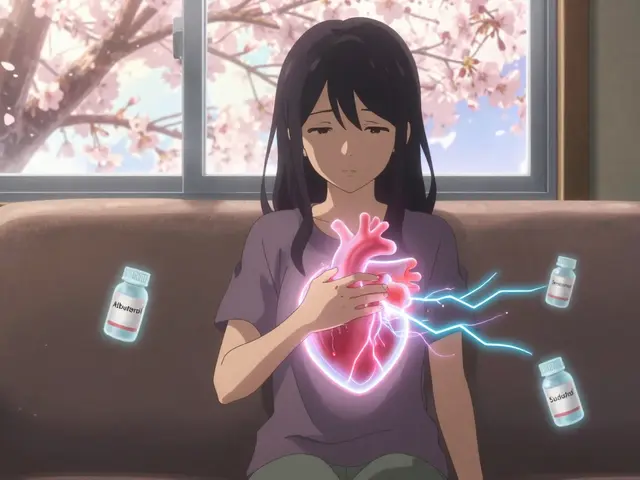
It’s not because SSRIs thin your blood like aspirin does. It’s because they mess with your platelets. Platelets are the tiny blood cells that rush to a cut and stick together to stop bleeding. They need serotonin-not the kind in your brain, but the kind stored inside platelets-to clump up properly. SSRIs block the serotonin transporter on platelets, draining their serotonin supply. Without it, platelets can’t aggregate well. Studies show this reduces platelet function by 30-40%. That’s enough to turn a minor nosebleed into something that won’t stop, or a small stomach ulcer into a life-threatening hemorrhage.The good news? SSRIs don’t directly interfere with the clotting cascade. A 2025 study tested citalopram at normal doses and found zero effect on thrombin generation, clotting time, or other coagulation markers. So the problem isn’t your liver making fewer clotting factors-it’s your platelets being too sluggish to respond.
Where Does the Bleeding Happen?
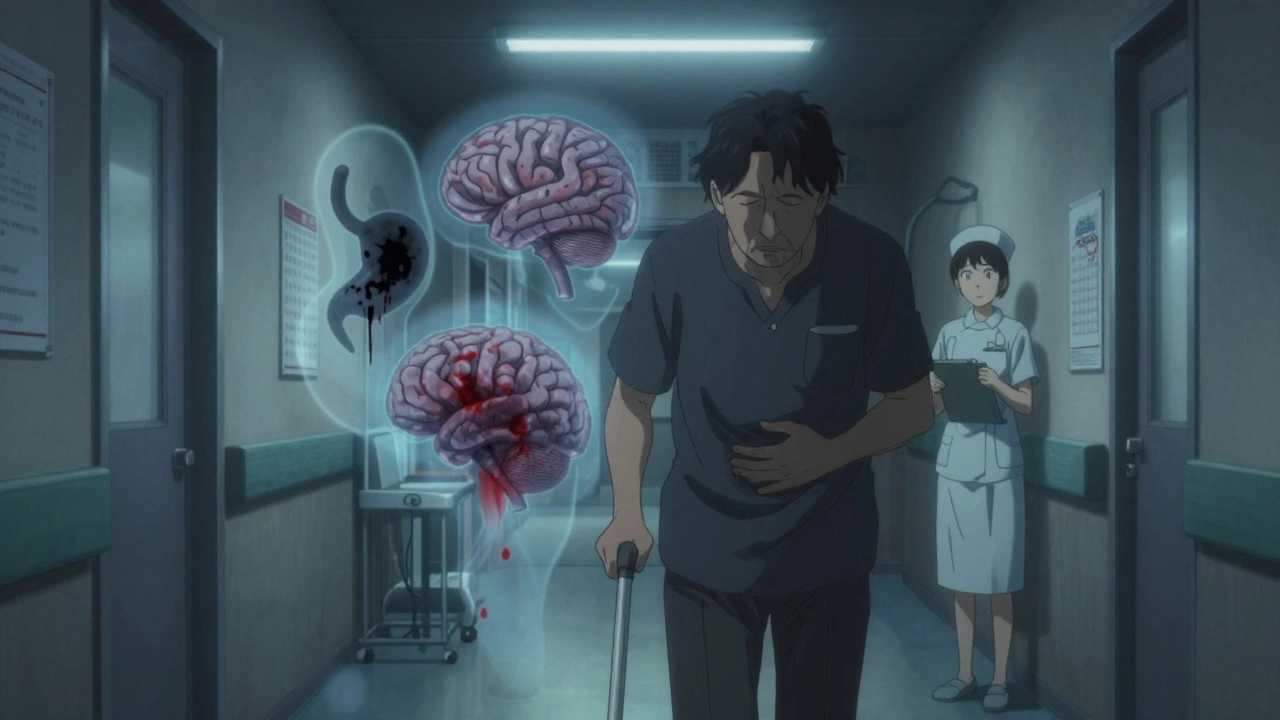
Not all bleeds are the same. The most common site is the gastrointestinal tract-58% of cases. That means black, tarry stools, vomiting blood, or unexplained anemia. Intracranial hemorrhage (bleeding in the brain) makes up 17% of cases. That’s the scary one. Even a small bleed in the brain can cause stroke-like symptoms or death. Other sites-like muscles, joints, or retroperitoneal spaces-account for the rest.Numbers don’t lie: if you’re only on an anticoagulant, your risk of major bleeding is about 1.8 events per 100 person-years. Add an SSRI, and that jumps to 2.4. That’s not a huge leap on paper, but when you’re the one bleeding, it’s everything.
Are Some Anticoagulants Safer Than Others?
Yes, but not by much. Warfarin (a vitamin K antagonist) carries a slightly higher risk when mixed with SSRIs-28% increase-compared to DOACs like apixaban or rivaroxaban, which show a 22% increase. But here’s the catch: that difference didn’t reach statistical significance. In plain terms, doctors can’t say one is definitively safer than the other when paired with an SSRI.That’s why guidelines now focus less on which anticoagulant you’re on, and more on your overall bleeding risk. If you have a HAS-BLED score of 3 or higher (meaning you’re older, have high blood pressure, kidney disease, or a history of bleeding), you’re already in the high-risk group. Adding an SSRI pushes you further over the edge.
Do Some SSRIs Carry More Risk Than Others?
You might think the strongest serotonin blocker-like paroxetine-would be the most dangerous. But data says no. In the largest study to date (42,000 patients, 2024), paroxetine, sertraline, escitalopram, and fluoxetine all carried the same 33% increased bleeding risk. Even though paroxetine blocks serotonin reuptake more potently in lab tests, real-world outcomes don’t reflect that difference. This contradicts older assumptions and means you can’t pick an SSRI based on bleeding risk alone.So if you’re choosing between SSRIs, pick based on depression symptoms, side effects, or drug interactions with other meds-not bleeding risk. Sertraline is still the most commonly prescribed in this group (52% of cases), not because it’s safest, but because it’s well-tolerated and has fewer CYP450 interactions than others like fluoxetine.
When Is the Risk Highest?
The first 30 days. That’s when your platelets are adjusting to the new drug, and your body hasn’t adapted. The 2024 JAMA study showed the risk peaks in the first month, then drops significantly after six months. That’s why most bleeding events happen early. It’s not a long-term problem-it’s an initial hazard.This is critical for doctors and patients alike. If you’ve just started an SSRI while already on an anticoagulant, watch for signs of bleeding: unexplained bruising, nosebleeds that won’t stop, blood in urine or stool, severe headaches, or dizziness. Tell your doctor immediately. Don’t wait.
Who’s Most at Risk?
It’s not just about the drugs. Your personal risk matters more. People with:- Age 65 or older
- History of GI ulcers or bleeding
- High blood pressure not under control
- Chronic kidney disease
- Alcohol use
- Concurrent use of NSAIDs (like ibuprofen or naproxen)
...are at the highest risk. The American Heart Association says about 22% of atrial fibrillation patients also have depression or anxiety. That’s millions of people on both types of meds. And a 2022 audit found 68% of risky combinations happen in primary care-where doctors may not have time to dig deep into drug interactions.
What Should You Do?
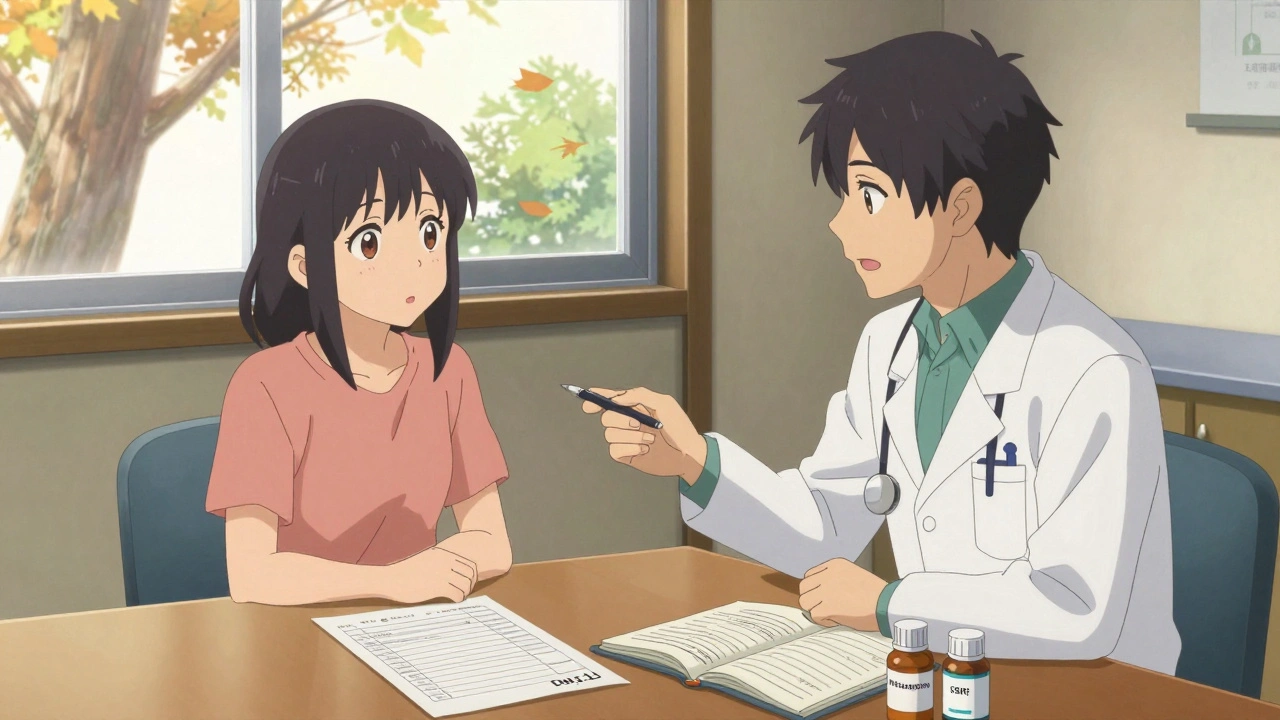
If you’re on both an SSRI and an anticoagulant:- Don’t stop either drug on your own. Depression and blood clots are both serious.
- Ask your doctor to check your HAS-BLED score. If it’s 3 or higher, discuss alternatives.
- Get a baseline CBC and fecal occult blood test. Repeat them monthly for the first three months.
- If you’re on warfarin, get your INR checked twice a week during the first month of starting the SSRI.
- Avoid NSAIDs. Use acetaminophen for pain instead.
- Watch for bleeding signs daily. Keep a symptom log.
There are alternatives to SSRIs. Mirtazapine and bupropion don’t affect platelets. They’re not perfect-mirtazapine can cause weight gain and sedation; bupropion can increase seizure risk-but they’re safer for bleeding. The European Heart Rhythm Association recommends them for high-risk patients.
What’s Changing Now?
The FDA updated anticoagulant medication guides in January 2025 to include clear warnings about SSRI interactions. They now recommend considering non-SSRI antidepressants for patients with other bleeding risks.The NIH is funding a major trial called PRECISION-AF, tracking 5,000 patients on SSRIs vs. non-SSRIs over the next year. Results will be out in late 2026 and could change guidelines again.
The American College of Cardiology is also pushing for clinical decision tools that combine your depression severity, HAS-BLED score, and medication history to recommend the safest antidepressant. Right now, that decision is often made on habit, not data.


13 Comments
man i just started sertraline last month and im on rivaroxaban for afib... this post just gave me chills. i never thought about platelets being affected like that. i thought it was just liver stuff. guess i gotta get that fecal test done pronto.
Oh please. Another ‘science is scary’ clickbait article written by someone who thinks ‘33% increase’ means you’re gonna bleed out of your eyeballs. The absolute risk is 0.6% per year. That’s less than getting struck by lightning. Meanwhile, untreated depression kills 800,000 people annually. You’re more likely to die from ignoring your mental health than from this ‘risk.’
So… you’re telling me the same SSRIs I’ve been on for 8 years are suddenly ‘dangerous’ because some guy with a spreadsheet says platelets are ‘sluggish’? I’m pretty sure my platelets are fine. I haven’t bled yet. Maybe the real problem is overmedicating? Or maybe the FDA just needs another way to sell more lab tests?
yo from india here. we got like 40% of our patients on warfarin + sertraline and no one talks about this. my uncle had a GI bleed last year-doc said ‘oh maybe the fluoxetine’ and just stopped it. no testing, no follow-up. we need more awareness, not just fancy studies. also… pls use acetaminophen, not ibuprofen. we see so many people ruin their kidneys with that stuff.
Wait-so SSRIs don’t affect the clotting cascade? That’s wild. So it’s purely a platelet serotonin thing? 🤯 I always thought it was like warfarin messing with vitamin K. This is like… a whole new lens. I’m gonna print this out and show my psych doc tomorrow. Also, mirtazapine? I’ve heard it makes you sleepy as hell. But if it saves me from a brain bleed… worth it. 🙏
It is profoundly irresponsible to suggest that the 33% relative risk increase is merely ‘not a huge leap on paper’-this is not a statistical abstraction, it is a physiological reality that manifests as hemorrhagic strokes, gastrointestinal perforations, and preventable deaths. The normalization of polypharmacy in primary care is a systemic failure of medical education, and until clinicians are trained to see drug interactions as existential threats-not just ‘possible side effects’-we will continue to bury patients under layers of well-intentioned prescriptions. This is not medicine. It is pharmacological roulette.
Wow. So you’re saying I shouldn’t take my antidepressant because I might bleed? What’s next? Don’t take blood pressure meds because you might get dizzy? You’re not a doctor. I’m on apixaban and fluoxetine. I’m 52. I’ve got 2 kids. I’m not dying because I’m depressed. And I’m not stopping my meds because some guy on Reddit says ‘33%.’ 😒
I’ve been on escitalopram and warfarin for 5 years. Never had a bleed. But I also check my INR every week, avoid NSAIDs, and got a colonoscopy last year. It’s not the drugs alone-it’s how you live with them. This article’s right: awareness matters. But fear? Fear doesn’t help. Discipline does. Monitoring. Communication. That’s the real treatment. And yes, the first month is the riskiest. I remember feeling like my gums were bleeding more… turned out it was just stress and brushing too hard. Still, I got it checked. Good call on the baseline CBC. That’s the kind of thing people skip.
SSRI + anticoagulant = bad. But depression = worse. Watch for bleeding. Use paracetamol. Talk to doc. Done.
Per the current literature, the serotonergic modulation of platelet aggregation via SERT inhibition constitutes a pharmacodynamic interaction that exacerbates hemostatic impairment in the context of direct oral anticoagulant (DOAC) or vitamin K antagonist (VKA) therapy. The hazard ratio for major bleeding is non-inferior across SSRI classes, suggesting a class effect rather than agent-specific liability. Clinical decision-making must integrate HAS-BLED stratification with pharmacogenomic profiling of CYP2D6/CYP2C19 polymorphisms to mitigate risk.
Oh great. So now I’m supposed to choose between ‘being happy’ and ‘not bleeding out.’ Because clearly, if I’m depressed, I’m just being dramatic and should ‘tough it out.’ Meanwhile, my doctor just scribbles ‘SSRI + apixaban’ like it’s a grocery list. No wonder people die. #MedicineIsBroken
I’m 67, on warfarin since my stroke, and on sertraline since my husband died. I don’t care if I bleed. I don’t care if I die. I just want to stop crying. But I can’t stop the meds. So I check my stool every morning. I cry when I see it’s black. And I don’t tell anyone. Because I’m weak. And I’m tired. And I just want to be quiet.
You got this. Check in with your doc. Log your symptoms. You’re not alone. And you’re not weak for needing help. 💪❤️
Write a comment