
Statin & Grapefruit Interaction Checker
Select the medication you are taking to see how grapefruit affects its metabolism in your body.
Mechanism
Blood Plasma Effect
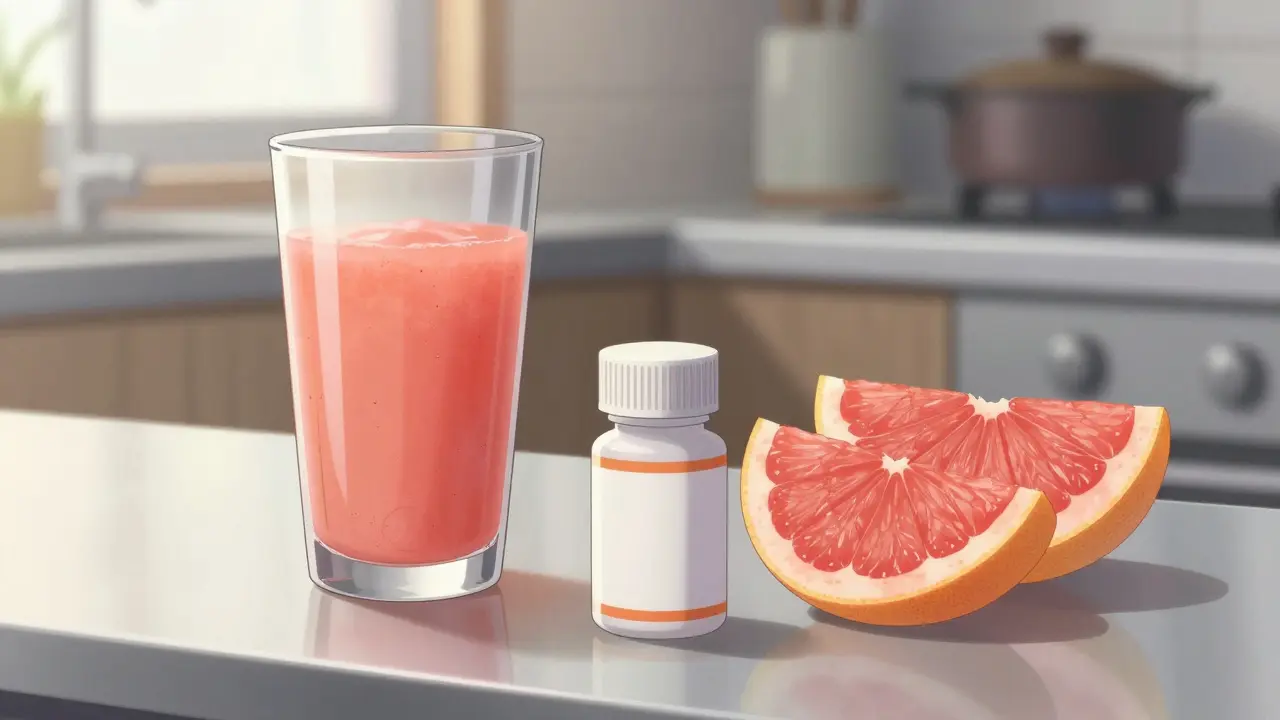
You might have seen a small warning label on your prescription bottle telling you to avoid grapefruit while taking your cholesterol medication. For many, it seems like a strange rule-why would a healthy piece of fruit interfere with a pill? The reality is that grapefruit contains specific compounds that act like a "jam" in your body's metabolic machinery, potentially turning a safe dose of medication into a dangerous overdose.
If you are taking statins and grapefruit, you aren't just dealing with a simple stomach ache. You're dealing with a complex biochemical reaction that can lead to severe muscle breakdown. While most people can enjoy a morning glass of juice without an issue, for those on specific statins, it can be a risky gamble. Here is exactly why this happens and how to manage your diet without compromising your heart health.
The Biological "Jam": How Grapefruit Blocks Your Enzymes
To understand the danger, we first have to look at how your body processes drugs. When you swallow a pill, it doesn't go straight into your bloodstream. It first passes through your small intestine and liver. In these areas, a specific protein called CYP3A4 is an enzyme responsible for breaking down and eliminating about 50% of all medications. Think of CYP3A4 as a security guard that decides how much of a drug actually enters your system.
Grapefruit contains natural chemicals known as furanocoumarins. These compounds are the troublemakers. They bind to the CYP3A4 enzyme and essentially "turn it off." This is called mechanism-based inhibition. Once these enzymes are blocked, the "security guard" is gone, and your body absorbs far more of the statin than your doctor intended.
Crucially, this happens primarily in the wall of your intestines. This is why drinking grapefruit juice has a massive impact, while an intravenous dose of the same drug wouldn't be affected-it bypasses the intestinal "jam" entirely. Even worse, this blockage isn't temporary. Research shows the effect can last up to 72 hours, meaning you can't simply take your pill in the morning and drink juice in the evening to avoid the interaction.
Not All Statins Are Created Equal
One of the biggest misconceptions is that all cholesterol meds react the same way. In reality, the risk depends entirely on which enzyme the drug uses to leave your body. Some statins are "CYP3A4 subscribers," while others use different pathways entirely.
| Interaction Level | Specific Medications | Why it Happens | Typical Risk |
|---|---|---|---|
| High | Simvastatin, Lovastatin | Heavily dependent on CYP3A4 | Significant plasma increase (up to 4x) |
| Moderate | Atorvastatin | Uses CYP3A4 but less sensitive | Moderate plasma increase (2-3x) |
| Low to None | Rosuvastatin, Pravastatin, Fluvastatin | Uses other enzymes (e.g., CYP2C9) or minimal metabolism | Negligible interaction |
For someone taking Simvastatin, the numbers are startling. Regular grapefruit consumption can increase the drug's concentration in the blood by nearly four times. It's effectively like taking four times your prescribed dose every single day, which puts an immense strain on your muscles and kidneys.
From Muscle Aches to Kidney Failure: The Side Effects
When statin levels spike in your blood, the most common result is myalgia, which is basically persistent muscle pain and soreness. While 5-10% of all statin users feel some muscle aches, grapefruit makes this much more likely. But the real danger is a rare, severe condition called rhabdomyolysis.
Rhabdomyolysis occurs when muscle tissue breaks down so rapidly that it releases a protein called myoglobin into the blood. This protein is too large for the kidneys to filter efficiently, which can lead to acute kidney failure. Imagine a 40-year-old woman taking a standard 20 mg dose of simvastatin; for some, just ten days of eating grapefruit can trigger this full-blown crisis.
If you are experiencing these red flags, you need medical attention immediately:
- Severe, unexplained muscle weakness (especially in the hips or shoulders).
- Deep muscle soreness that feels like a severe flu.
- "Tea-colored" or dark brown urine, which is a telltale sign of myoglobin leaking through the kidneys.
Practical Rules for Your Diet
You don't have to live in fear of every citrus fruit, but you do need a strategy. The first thing to understand is that fresh fruit, bottled juice, and even grapefruit-flavored extracts all contain the furanocoumarins that cause the problem. You can't "cheat" the system by switching from juice to a whole fruit.
Depending on your prescription, here are the general rules of thumb based on FDA and clinical guidance:
- If you take Simvastatin or Lovastatin: Avoid grapefruit products entirely. The risk of a massive plasma spike is too high to justify a glass of juice.
- If you take Atorvastatin: You can be more flexible, but limit yourself to one small glass (about 200 mL) per day. Avoid binge-consuming grapefruit over a weekend.
- If you take Rosuvastatin or Pravastatin: You can generally enjoy grapefruit in moderate amounts without worrying about this specific interaction.
If you absolutely love grapefruit and can't imagine your breakfast without it, don't just stop taking your meds. Stopping statins increases your risk of heart attack and stroke by 25-35%. Instead, talk to your doctor about switching to a non-CYP3A4 metabolized statin like rosuvastatin. This allows you to keep your cardiovascular protection without sacrificing your favorite food.
Common Pitfalls to Avoid
A big mistake people make is thinking they can time their medication and their food to avoid the interaction. You might think, "I'll take my pill at 8 AM and have my juice at 4 PM." This does not work. Because furanocoumarins irreversibly disable the enzymes in your gut, the "door" remains open for the drug to flood your system for several days. The timing of the dose is irrelevant.
Another common error is assuming other citrus fruits are just as dangerous. While some Seville oranges or pomelos can have similar effects, most common oranges and lemons are perfectly safe. The "forbidden fruit" is primarily the grapefruit.
Does grapefruit juice interact with all cholesterol medications?
No. Only statins that are metabolized by the CYP3A4 enzyme-such as simvastatin, lovastatin, and atorvastatin-interact significantly. Others, like pravastatin and rosuvastatin, have little to no interaction with grapefruit.
Can I just eat the fruit instead of drinking the juice?
No. Both the whole fruit and the juice contain furanocoumarins, the compounds responsible for blocking the CYP3A4 enzyme. Both will increase the concentration of certain statins in your blood.
How long does the effect of grapefruit last in my system?
The inhibition of the CYP3A4 enzyme can last for up to 72 hours. This means that separating the time you take your medication from the time you consume grapefruit will not prevent the interaction.
What are the signs of a dangerous statin interaction?
The most serious sign is rhabdomyolysis, characterized by severe muscle weakness, deep soreness, and dark, tea-colored urine. If you notice these symptoms, contact a doctor immediately as it can lead to kidney failure.
Are other citrus fruits like oranges or lemons safe?
Generally, yes. Most common oranges and lemons do not contain the levels of furanocoumarins found in grapefruit. However, some specialty varieties like Seville oranges can cause similar interactions, so use caution with rare citrus types.


13 Comments
Oh, so we're just blindly trusting the "security guard" analogy now? 🙄 Typical. The pharmacological reality is way more chaotic than a little chart. Most people just ignore these warnings anyway because they love their breakfast more than their kidney function. It's honestly hilarious how some folks think a little juice is "natural" and therefore harmless while the pill is "chemical" and scary. Give me a break. 🤡
It is truly fascinating how we perceive the limitations of our own biology as a series of obstacles rather than a cosmic dance of chemistry and consequence, and frankly, the way most of you approach medication is just laughable. You see a warning label and you treat it like a suggestion, ignoring the deeper metaphysical truth that our bodies are delicate vessels that react to the smallest tremors of chemical imbalance, and yet people still act surprised when their muscles start disintegrating. The sheer audacity of the average consumer to believe that "timing" a dose will somehow trick a biological system that operates on a 72-hour inhibition cycle is a testament to the widespread intellectual bankruptcy regarding basic biochemistry. We live in an era where information is available at the click of a button, yet the collective consciousness remains stubbornly tethered to the idea that a piece of fruit is benign. If you cannot grasp the concept of enzymatic blockage, perhaps you shouldn't be managing your own prescriptions in the first place, because the gap between a "healthy snack" and a "metabolic disaster" is a void that only education can bridge, and most are too lazy to cross it. It's just sad, really, that the nuance of CYP3A4 is lost on a population that thinks a "pill" is just a magic bean rather than a precisely calibrated chemical tool. You're not just fighting cholesterol; you're fighting your own ignorance of how a furanocoumarin essentially hijacks your gut's infrastructure. Truly pathetic.
Follow the money! Why is this just about grapefruit? I bet the big pharma companies just want us on a specific list of "approved" fruits so they can sell us synthetic supplements later. This whole "enzyme" story is a perfect cover for how they control our metabolic rates from the inside out. Wake up people! They tell you it's a "jam" in the machinery, but maybe the machinery is designed to fail so you keep paying for the repairs!
Whoa, let's dial it back a notch. We're just talking about pharmacokinetics here. The bioavailability of the drug spikes because the first-pass metabolism is compromised. It's basically a textbook case of drug-nutrient interaction. Just keep your head in the game, talk to your provider, and pivot to a different statin if the grapefruit is a non-negotiable part of your morning ritual. We got this!
Wow thnx for the heads up! Had no clue about the 72 hour thing.. scary stuff!!
I've seen a few patients get really confused about the Seville orange thing too. Its def better to just stick to regular navels if you're on simvastatin just to be safe!!
This is actually super helpful!!! I never realized that the effect lasted for three whole days... that is wild!!!
The systemic manipulation of the cytochrome P450 superfamily is a known variable in pharmacological titration... however, the insistence on utilizing these specific lipid-lowering agents despite known contraindications suggests a coordinated effort to maintain patient dependency on high-cost pharmaceutical interventions!!!
Exactly!!! They just want us sick and tired 😡🇺🇸 Stop letting these fruits mess with your health!!! 💊🙅♀️
The lack of basic pharmacological literacy in this thread is quite distressing. One should simply read the monograph before consuming the medication
It's like a tiny chemical sabotage in the gut. A little bit of zest turning into a biological riot. Such a wild twist on "eating healthy"!
It's great that there are alternative options like rosuvastatin for those who love their citrus.
The disregard for official medical warnings is simply unacceptable within this great nation... one must adhere to the FDA guidlines strictly!!
Write a comment