

Vitamin K Intake Tracker
Why Consistency Matters
Your body adapts to your vitamin K intake. Eating 90-120 mcg daily keeps your INR stable. Fluctuations cause dangerous swings.
90-120 mcg Daily target range
Your Daily Intake
When you're on warfarin, your diet isn't just about eating healthy-it's about eating consistent. A sudden plate of kale or a big bowl of spinach can throw your INR off balance, and that’s not just a number-it’s a risk. Too high, and you could bleed. Too low, and you could clot. The good news? You don’t have to give up greens. You just need to know how to manage them.
Why Vitamin K Matters with Warfarin
Warfarin works by blocking vitamin K from helping your blood clot. That’s exactly what you want if you’re at risk for strokes or blood clots. But vitamin K isn’t some villain. It’s essential for healthy bones and circulation. The problem isn’t vitamin K itself-it’s change. When your intake jumps around, your INR jumps around too.Studies show that if you eat 250 micrograms (mcg) of vitamin K in a day, your warfarin dose may need to be higher than someone eating only 90 mcg. That’s not because one is better-it’s because your body adapts. If you eat 100 mcg every day, your INR stays steady. If you eat 30 mcg one day and 200 mcg the next, your INR swings like a pendulum.
Top Vitamin K Foods You Need to Track
Not all greens are equal. Some pack a serious punch. Here’s what you’re really dealing with:- Cooked spinach: 889 mcg per cup
- Cooked kale: 547 mcg per cup
- Cooked collard greens: 772 mcg per cup
- Cooked broccoli: 220 mcg per cup
- Raw spinach: 145 mcg per cup
- Asparagus: 70 mcg per half-cup
- Green beans: 14 mcg per half-cup
Notice the difference between raw and cooked? Cooking concentrates vitamin K. A cup of raw spinach has less than half the K of cooked. That’s why swapping raw for cooked-without realizing it-can drop your INR overnight.
The Consistency Rule: Not Restriction
For years, doctors told patients to avoid vitamin K. That advice is outdated-and dangerous. The American Heart Association, American College of Cardiology, and American Society of Hematology all agree: don’t restrict. Stick to consistency.Why? Because people who cut out greens often end up eating them anyway-maybe during holidays, or when a friend makes a salad. That one-time spike can crash your INR. Worse, they lose confidence in their diet. They start guessing. And guessing with warfarin is risky.
Patients who eat 90-120 mcg of vitamin K daily, with little day-to-day change, spend 75-80% of their time in the ideal INR range (2.0-3.0). Those who fluctuate? Only 55-65%. That’s a 20% difference in safety.
Real-Life Strategy: Pick One, Eat It Daily
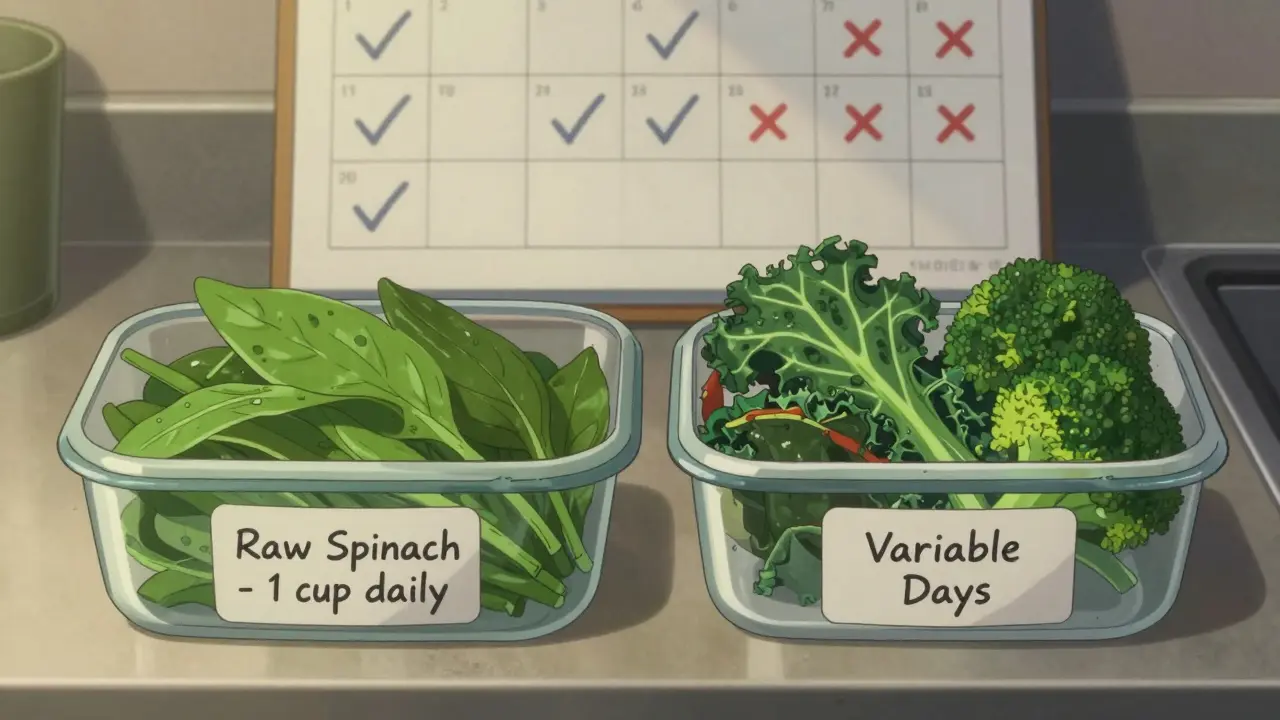
You don’t need to count every microgram. You need a routine.One patient, 68, from Ohio, used to eat spinach salad three times a week. Her INR bounced from 1.9 to 3.4. Her doctor told her to eat one cup of baby spinach every morning-raw, not cooked. Same portion. Same time. Same day. In six months, her time in range jumped from 52% to 81%.
Here’s how to do it:
- Choose one high-vitamin K food you like: spinach, broccoli, or even Brussels sprouts.
- Decide on a standard portion: one cup raw, half a cup cooked.
- Eat it every day, at the same meal-breakfast, lunch, or dinner.
- Don’t vary it. No kale on Monday, collards on Wednesday. Stick to your one.
That’s it. No need to avoid. No need to panic. Just repeat.
What About Other Foods and Supplements?
It’s not just greens. Some hidden sources can mess with your INR:- Meal replacement shakes (Ensure®, Boost®): 50-55 mcg per serving
- Some multivitamins: up to 100 mcg of vitamin K
- Antibiotics: kill gut bacteria that make vitamin K2, which can raise your INR
- Green tea: moderate amounts are fine, but large doses may interfere
Always check labels. If you take a supplement, tell your anticoagulation clinic. Even if it says “natural,” it might contain vitamin K.
What Happens When You Get Sick?
When you’re sick, you eat less. That means less vitamin K. And that can make your INR rise-even if you’ve been consistent.Studies show that during illness, INR can increase by 0.3 to 0.6 units within 48 hours. That’s why you need to check your INR more often when you’re not feeling well. Don’t wait for your next scheduled test. Call your clinic. They’ll tell you if you need an early check.
Technology Can Help-But Don’t Overcomplicate It
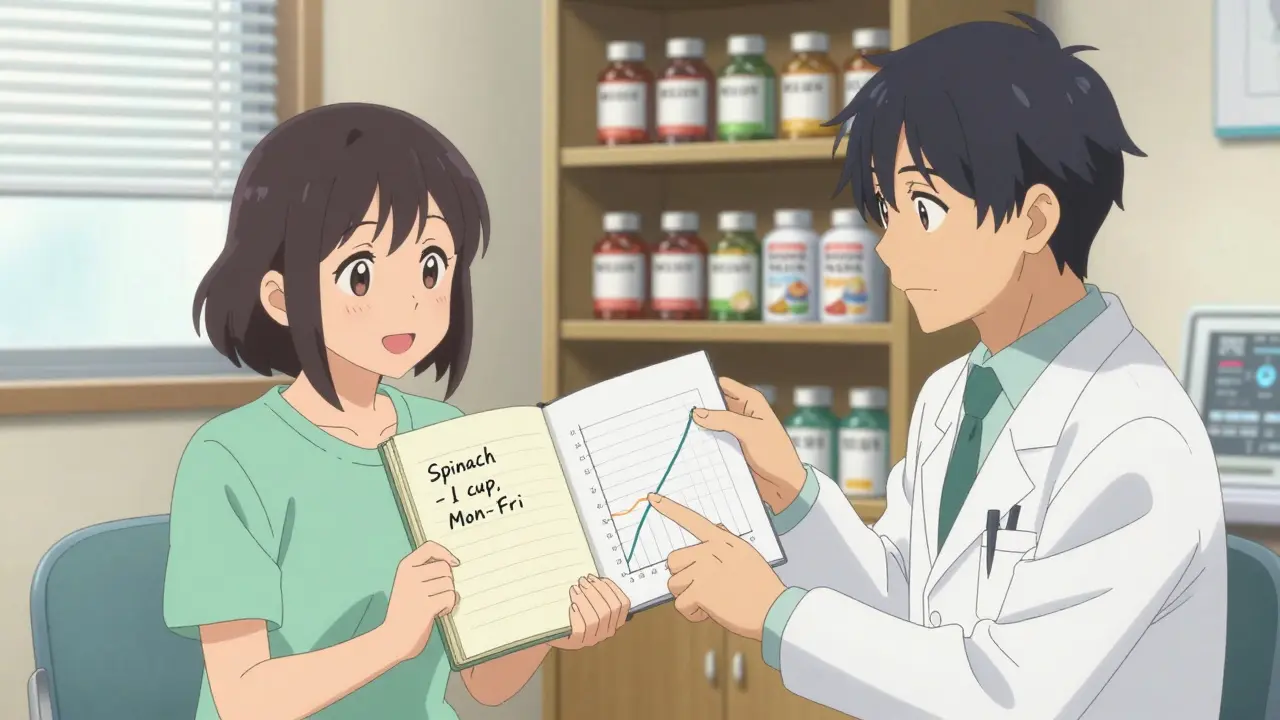
Apps like CoumaDiet and INR Tracker Pro are popular for a reason. They let you log meals and see your vitamin K intake. But you don’t need an app to succeed.Many patients find simple tools work better: a notebook, a calendar, or even a sticky note on the fridge. Write down what you ate. “Spinach-1 cup.” That’s enough. The goal isn’t perfection-it’s pattern.
One study showed patients using smartphone apps improved their time in range by 12%. But the biggest win? Confidence. Knowing you’re doing the same thing every day reduces anxiety.
Why Some Doctors Still Get It Wrong
Despite updated guidelines, 41% of primary care doctors still tell patients to avoid leafy greens. That’s partly because they’re not trained in anticoagulation. It’s also because old habits die hard.If your doctor says “avoid spinach,” ask: “Can I eat the same amount every day instead?” If they hesitate, ask for a referral to an anticoagulation clinic. They specialize in this. They’ve seen thousands of patients get stable-not by avoiding food, but by mastering routine.
What About New Blood Thinners?
Drugs like apixaban and rivaroxaban don’t care about vitamin K. No diet tracking. No INR checks. But they cost 20 times more than warfarin. For many people, especially those on fixed incomes, warfarin is the only option.And here’s the truth: even with newer drugs, diet still matters. Some foods interact with DOACs. But the stakes aren’t as high. With warfarin, consistency isn’t optional-it’s the foundation.
Final Tip: Plan Your Week
Meal prep isn’t just for fitness people. It’s for warfarin users too.On Sunday, cook one batch of steamed broccoli. Portion it into five containers. Eat one every day. No guesswork. No last-minute swaps. No surprise kale salads.
Or buy pre-washed baby spinach. One cup a day. Same time. Same plate. That’s your anchor.
Stability doesn’t come from perfection. It comes from repetition. Your body doesn’t need to be shocked by vitamin K. It just needs to know what’s coming next.
Can I eat spinach if I’m on warfarin?
Yes-but only if you eat the same amount every day. One cup of raw spinach (about 145 mcg of vitamin K) is fine. But don’t eat two cups one day and none the next. Consistency matters more than quantity.
Should I avoid all green vegetables on warfarin?
No. Avoiding greens increases your risk of INR swings. The current guidelines say to eat a consistent amount of vitamin K daily. Cutting them out entirely can backfire if you accidentally eat them later.
Why does cooking spinach increase vitamin K?
Cooking reduces the volume of spinach, so you’re eating more leaves per cup. One cup of raw spinach is mostly water. When you cook it, it wilts down to a quarter of its size. That means a cup of cooked spinach has four times the greens-and four times the vitamin K.
Can vitamin K supplements help stabilize my INR?
Yes-for some people. A 2020 study found that taking 100-150 mcg of vitamin K daily actually improved INR stability in patients with erratic levels. But only do this under medical supervision. Don’t start supplements on your own.
How long does it take to get stable on warfarin with diet changes?
Most people see improvement in 8-12 weeks. INR stability typically improves by 5% per month after establishing a consistent diet. The key is sticking with your routine, even when it feels boring.
What should I do if I eat a lot of vitamin K by accident?
Don’t panic. Don’t skip your next warfarin dose. Call your anticoagulation clinic. They’ll check your INR and adjust your dose if needed. One high-vitamin K meal won’t cause a clot or bleed-but repeated changes will.
What Comes Next?
If you’re struggling with your INR, don’t blame your diet. Blame the inconsistency. The goal isn’t to eat perfectly. It’s to eat predictably. Pick one food. Eat it daily. Track it. Talk to your clinic. You’ve got this.Warfarin isn’t a life sentence of restrictions. It’s a partnership-with your food, your body, and your care team. And consistency? That’s your strongest tool.


12 Comments
Man, I wish I’d known this five years ago. I used to go nuts with kale smoothies on Mondays and then eat nothing green for the rest of the week. My INR would flip like a coin. Now I eat one cup of raw spinach every morning with my eggs-same time, same portion. No more panic calls to my anticoagulation clinic. Consistency isn’t sexy, but it’s the only thing that keeps me alive.
And yeah, cooking spinach? Total game-changer. Raw = 145 mcg. Cooked? Almost 900. I learned that the hard way after a ‘healthy’ spinach soup landed me in the ER. Don’t be me.
so i just eat the same thing every day and im good right? like maybe just baby spinach every morning? no need to stress about the rest? i think i can do that
thanks for this i feel less scared now
Let’s be real-this advice is only useful if you have the time, money, and mental bandwidth to meal prep seven days a week. What about people working two jobs? Or those who rely on food banks? Or elderly folks who can’t chop vegetables? This isn’t ‘consistency,’ it’s privilege wrapped in medical jargon.
And don’t get me started on the ‘one food daily’ nonsense. That’s not a strategy, it’s a cult. Your body needs variety. Restricting yourself to spinach like some kind of vitamin K monk is just as dangerous as bingeing on kale. The real issue? The system doesn’t support people. It just tells them to fix themselves.
Also, vitamin K2 from fermented foods? Ignored. Gut health? Ignored. The fact that antibiotics mess with INR? Mentioned once. This article reads like a pharma pamphlet disguised as patient empowerment.
Great breakdown. I’ve been on warfarin for 12 years and this is the first time I’ve seen a clear, non-judgmental guide.
I used to avoid greens entirely until my INR kept creeping up. Turns out, my body was making its own K2 from gut bacteria, and when I stopped eating anything, my liver got confused. Now I eat 1/2 cup steamed broccoli every night. No apps. Just a sticky note on my fridge. My time in range went from 58% to 84%.
And yes-check your multivitamin. I lost three months of stability because I took a ‘natural’ supplement with 120 mcg of K. Didn’t even realize it was in there. Always read the label.
Also, if your doctor says ‘avoid spinach,’ ask for a referral to an anticoagulation clinic. They’re not just for emergencies. They’re your real allies.
omg i just ate a huge salad last night and now i’m terrified. is it too late? should i skip my warfarin? i feel like i’m gonna die. why did no one tell me this sooner? i hate my life.
can someone just hold my hand? i’m crying right now
In India, we eat lots of fenugreek leaves and curry leaves-both high in vitamin K. Many patients here don’t know this. We also use mustard oil, which has vitamin K too. My uncle was on warfarin and kept having INR spikes until we tracked his daily dal and saag intake. Consistency works everywhere. You don’t need fancy apps. Just know what you eat. Simple.
Also, turmeric? Safe. Ginger? Safe. Garlic? Moderate. But green chilies? High K. Be careful.
Look, I’ve been on warfarin since 2015 and I’ve seen it all. People think they’re being ‘healthy’ by eating kale every day. Newsflash: kale is a warfarin nightmare. You want stable? Stick to broccoli. It’s got enough K to keep your INR happy but not enough to make you a walking lab report.
And for God’s sake, stop drinking green tea like it’s water. One cup? Fine. Five? You’re asking for trouble. I had a bloke in the clinic who drank 3 liters of matcha a day. He had a stroke. Not joking.
Also, if you’re using meal replacement shakes, you’re already playing Russian roulette. Read the label. Or just eat real food. It’s cheaper and less likely to kill you.
That ‘one food daily’ rule is a myth. It’s not about the food-it’s about the dose. If you eat 100 mcg of K from spinach, your liver adapts. If you switch to broccoli, your liver doesn’t know the difference. The real variable is total daily intake, not the source.
Also, the 90-120 mcg range? Arbitrary. I’ve seen people stable on 50 mcg and others on 180 mcg. It’s not one-size-fits-all. This article treats patients like robots. You need individualized care, not a diet template.
I used to think I had to give up my love of greens forever. Then I found my anchor: one cup of raw baby spinach every morning with my coffee. No more guessing. No more guilt. No more ‘what if I ate too much?’
My INR went from ‘I need a new doctor’ to ‘I’m actually proud of myself.’ I even started meal prepping on Sundays-portioning out spinach in mason jars like a wellness guru. My husband laughs, but he’s the one who hasn’t had to call the clinic in 18 months.
And yeah, the supplements? I ditched my multivitamin. Found a K-free one. Best decision ever. You don’t need to be perfect. You just need to be predictable. And honey? That’s power.
There is a critical omission here: the interaction between vitamin K and gut microbiota. Vitamin K2 is synthesized by intestinal bacteria, and antibiotics-especially broad-spectrum ones-can drastically reduce this endogenous production, leading to elevated INR independent of dietary intake.
Furthermore, the assumption that all patients can reliably consume the same portion size daily ignores cognitive load, socioeconomic barriers, and functional limitations. A 78-year-old with arthritis may not be able to consistently measure one cup of spinach. The advice is clinically sound but socially naive.
Additionally, the 2020 study cited regarding vitamin K supplementation for stabilization should be contextualized: it was conducted in a controlled clinical setting with frequent INR monitoring. Self-administered supplementation without supervision carries significant risk of overshooting and inducing hypercoagulability.
Finally, the phrase ‘your body doesn’t need to be shocked’ is misleading. The body thrives on variability. What’s needed is not homogeneity, but predictability-and that distinction matters profoundly in clinical practice.
Western medicine is so obsessed with control it forgets the body is alive. You don’t fix warfarin with spinach routines. You fix it with trust-with letting go. My grandmother took warfarin for 20 years. She ate what she wanted, when she wanted. She never measured anything. She lived to 97. She didn’t die from INR swings. She died from old age.
Stop treating patients like lab rats. Stop forcing consistency. Stop making people afraid of their own food. You don’t need to eat the same spinach every day. You need to live your life. Let your body adapt. Let your soul breathe.
And if you’re still scared? Go to India. We don’t count micrograms. We count blessings. And our warfarin patients live longer than yours.
@6616 - I hear you. My grandma did the same thing. Ate whatever, never checked. Lived to 93. But she didn’t have a mechanical heart valve. I do. My body doesn’t get to wing it. The stakes are different.
And yeah, maybe you don’t need to measure. But if you want to live past 60 with a valve? You do. I’m not trying to control my body. I’m trying to outsmart a drug that makes my blood thin. That’s not paranoia. That’s survival.
Also, your grandma probably had a different INR target. Mine’s 2.5–3.0. That’s not a suggestion. It’s a requirement. I’m not rejecting your wisdom. I’m just saying: not everyone’s grandma had the same rules.
Write a comment