

By the time you hit your 60s, there’s a good chance your vision has started to feel a little foggy-like looking through a frosted window. That’s not just aging. It’s cataracts, a natural, common change in the eye’s lens that slowly clouds your sight. It doesn’t hurt. It doesn’t come on suddenly. But over time, it makes driving at night harder, colors look dull, and reading small print feel impossible. The good news? This isn’t something you have to live with. Modern cataract surgery is one of the most successful medical procedures in history, with over 95% of patients seeing a major improvement in their vision.
What Exactly Happens in Your Eye?
Your eye works like a camera. Light enters through the clear front surface-the cornea-then passes through the lens, which focuses the image onto the retina at the back. The lens is made of proteins and water, arranged in a precise way to keep things sharp. As you get older, those proteins start to break down and clump together. It’s like milk turning cloudy when it spoils. This cloudiness is a cataract. It doesn’t grow like a tumor. It doesn’t spread. It just gets thicker, blocking more light and scattering what gets through. That’s why glare from headlights or bright sunlight becomes unbearable, and why your glasses don’t seem to help anymore.
The National Eye Institute found that about 24.4 million Americans over 40 had cataracts in 2019. That number keeps climbing as the population ages. It’s not just about getting older, though. Diabetes, smoking, long-term steroid use, and even too much sun exposure without UV protection can speed things up. But for most people, it’s simply time.
How Do You Know It’s Time for Surgery?
Not everyone with a cataract needs surgery right away. If you can still read, drive safely, and do your daily tasks, your doctor might just suggest waiting. But when the clouding starts to interfere with your life-that’s the signal. Can’t see the clock in the morning? Struggling to recognize faces? Feeling anxious driving after dark? These aren’t just inconveniences. They’re signs your vision is slipping away.
There’s no medicine, no eye drop, no supplement that can reverse a cataract. Once it’s there, surgery is the only way to get your sight back. And it’s not the scary, risky procedure people used to think it was. Today’s cataract surgery is quick, safe, and done as an outpatient visit. You walk in, get numbed with eye drops, and you’re out within 30 minutes.
The Surgery: What Actually Happens
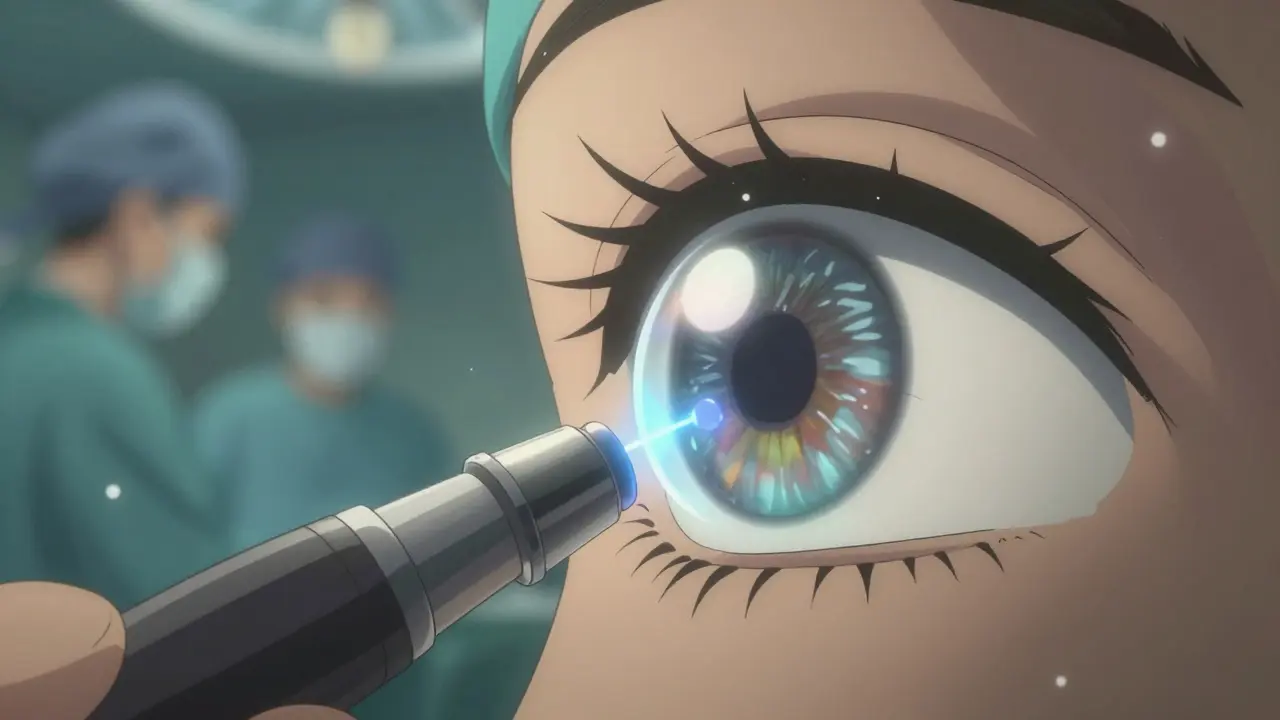
Over 95% of cataract surgeries today use a technique called phacoemulsification. A tiny probe, thinner than a pencil tip, is inserted through a 2.2- to 2.8-millimeter opening in the side of your eye. It uses ultrasound waves to break the cloudy lens into small pieces, then gently suctions them out. The lens capsule-the thin, clear bag that held your natural lens-stays in place. Into that space, a new artificial lens, called an intraocular lens (IOL), is folded and inserted. Once inside, it unfolds and locks into position.
This isn’t like replacing a lightbulb. The IOL becomes part of your eye. It doesn’t move. It doesn’t need cleaning. It lasts for life. And today, there are options. The most common is the monofocal IOL. It gives you clear distance vision, but you’ll still need reading glasses for close work. That’s fine for many people. But if you want to reduce your dependence on glasses, there are premium lenses. Multifocal IOLs let you see at multiple distances. Toric IOLs correct astigmatism. Newer trifocal lenses, like Alcon’s PanOptix, even improve your intermediate vision-perfect for reading a computer screen.
Costs vary. Medicare covers the basic monofocal lens and surgery. But if you choose a premium lens, you pay out of pocket. Prices range from $1,500 to $4,500 per eye, depending on the lens type and location. It’s an investment, but for most, the improvement in quality of life is worth it.
Recovery: What to Expect
Right after surgery, your vision will be blurry. That’s normal. Your eye needs time to heal. You might feel a scratchy, gritty sensation for a day or two. Mild discomfort is common, but sharp pain isn’t. If you have it, call your doctor.
Most people notice better vision within 1 to 3 days. Colors look brighter. Contrast is sharper. You might be surprised how vivid the world suddenly is. One Reddit user described it as seeing “HD for the first time in decades.” But full recovery takes longer. Cleveland Clinic says four weeks. MyHealth Alberta says 3 to 10 weeks. West Boca Eye Center says 6 to 8 weeks. Why the difference? Everyone heals differently. If you had a very advanced cataract or another eye condition like diabetes, it may take longer.
You’ll get eye drops. Antibiotics to prevent infection. Steroids to reduce swelling. You’ll use them exactly as prescribed-usually four times a day for the first week, then tapering off over the next few weeks. Skip them, and you risk complications.
For the first few weeks, avoid heavy lifting, bending over with your head below your heart, and getting water in your eye. No swimming. No hot tubs. No rubbing your eye. And absolutely no driving until your doctor says it’s safe. Even if you feel fine, your depth perception might be off. One patient on Reddit said the weirdest part was how his brain had to “relearn” how to judge distance.
What About Glasses After Surgery?
Even after a successful surgery, you might still need glasses. If you got a monofocal lens, you’ll likely need them for reading or computer work. That’s expected. But if you chose a multifocal or toric lens, you might not need glasses at all. Clinical studies show 81% of people with trifocal lenses and 89% with extended depth-of-focus lenses don’t need glasses for daily tasks. Still, no lens is perfect. Some people notice halos around lights at night, especially in the first few months. That usually fades as your brain adapts.

Complications? Rare, But Possible
Over 99.5% of cataract surgeries are complication-free, according to a 2022 review of over a million procedures. But like any surgery, risks exist. Infection is rare-less than 1 in 1,000. Bleeding is even rarer. The most common issue is posterior capsule opacification (PCO). That’s when the back of the lens capsule, which was left in place, gets cloudy months or years later. It’s not a new cataract. It’s scar tissue. And it’s easily fixed with a quick, painless laser procedure called YAG capsulotomy. No incision. No downtime. Just a flash of light, and your vision clears again. About 20-30% of patients need this within five years.
What’s Next for Cataract Surgery?
Technology keeps improving. New IOLs are being designed to mimic the natural lens’s ability to focus at different distances-what’s called accommodating IOLs. These are in late-stage trials and could be available soon. Zeiss’s AT LISA tri 839MP, approved in early 2023, already gives better intermediate vision for screen use. The global market for cataract devices is expected to hit $6.32 billion by 2027, driven by aging populations and smarter lens designs.
Is It Worth It?
If you’re tired of squinting, avoiding night driving, or feeling like your world is fading, yes. Cataract surgery isn’t just about seeing better. It’s about living better. Studies show people who get the surgery report higher confidence, fewer falls, better mood, and even improved memory. Vision is one of the senses most tied to independence. When it fades, so does your freedom. When it’s restored, you get your life back.
You don’t need to wait until you’re completely blind. Talk to your eye doctor when your vision starts to limit your daily life. Don’t assume it’s just “getting old.” It’s treatable. And it’s never too late to see clearly again.




11 Comments
Man i just got mine done last month. World went from blurry mess to HD overnight. Didn't think it'd be this easy. My grandkids look like they're right in front of me now. Best decision ever.
While the assertion regarding the efficacy of modern cataract surgery is statistically valid, one must critically examine the underlying assumptions concerning the universal applicability of intraocular lens (IOL) technology. The clinical data presented omits significant demographic disparities in postoperative outcomes, particularly among elderly populations with comorbid neurodegenerative conditions. Furthermore, the economic framing of premium IOLs as a 'worthwhile investment' constitutes a neoliberal distortion of healthcare access, ignoring systemic inequities in Medicare coverage and out-of-pocket expenditures.
Excellent breakdown. I'm an ophthalmic technician in Lagos, and I've seen firsthand how cataract surgery transforms lives-especially in rural areas where people used to rely on family members just to walk safely. The YAG capsulotomy point is spot-on; it's such a simple fix, yet so many patients don't know it exists. Also, UV protection isn't just for beach days-daily sun exposure without sunglasses accelerates lens damage. A simple pair of $5 UV-blocking shades can delay cataracts by years.
It's wild how something so simple-cloudy lenses-can steal your independence. I remember my mom refusing surgery for years because she thought 'it was just aging.' But the day she could see her garden again? She cried. Vision isn't just sight. It's connection. It's joy. It's remembering what the color of your granddaughter's dress looks like. Don't wait until you're scared. Just go.
The scientific accuracy of the article is commendable. However, I would like to emphasize the importance of preoperative evaluation for patients from developing nations, where nutritional deficiencies such as vitamin A and E may influence postoperative healing. Additionally, cultural perceptions of surgery often delay intervention. Community health workers should be trained to demystify cataract procedures, as fear of the unknown remains a significant barrier in many regions.
Let's be real-this whole thing is a money grab. Insurance covers the basic lens, but they push you to upgrade to $4,000 lenses like it's a luxury car. And don't get me started on the 'HD for the first time' nonsense. You're not seeing better-you're seeing differently. Your brain is compensating. And what about the halos? The glare? The fact that half the people who get premium lenses end up with worse night vision? This isn't magic. It's marketing dressed up as medicine.
My grandma had surgery last year. She said the weirdest part wasn't the vision-it was how quiet the world became. No more muffled sounds. She could hear birds again. And the way she looked at her old photos? Like she was seeing them for the first time. I didn't realize how much she'd been holding back, just to not seem 'old.' This isn't just about eyes. It's about coming back to yourself.
so i got the multifocal lens and honestly? i still need glasses for reading. the ads make it seem like you're magically free but nah. also the halos at night are wild. like driving home from work felt like i was in a sci-fi movie. took 3 months to adjust. worth it? kinda. but don't believe the hype.
That's exactly what I experienced too. I went in thinking 'free vision' and came out with a new set of problems. But here's the thing-I still see way better than before. The halos? Yeah, they're annoying. But I can read street signs at night now. I'll take it. And honestly? The fact that they're improving lenses every year means next time, it'll be even better.
The article provides a clinically accurate overview of contemporary cataract management. However, the omission of long-term data on IOL material degradation beyond 15–20 years remains a gap in the current literature. While the procedure is statistically safe, the assumption of lifelong lens integrity warrants further longitudinal study, particularly with the increasing prevalence of newer polymer-based IOLs.
My mom had surgery in Delhi. She didn't even know what a cataract was. The clinic gave her free lens because she's low income. Now she reads books again. No halos, no problems. I think we need more programs like this. Not everyone needs fancy lenses. Just clear vision.
Write a comment