

Comorbidity & Drug Risk Estimator
Select applicable factors based on the article data.
Risk Analysis
Reset Tool
Imagine taking a standard dose of medication that works perfectly for your neighbor but leaves you dizzy, weak, or worse. It isn’t just bad luck. If you have existing health conditions-what doctors call comorbidities is the presence of one or more additional diseases or disorders occurring simultaneously with an initial disease-your body processes drugs differently. In fact, patients with comorbidities are nearly three times more likely to experience adverse drug reactions (ADRs) is harmful or unintended responses to a medication at normal doses than those without them. This isn't a minor footnote in medical literature; it’s a critical safety issue that affects millions of people managing chronic illnesses like diabetes, heart disease, or kidney issues.
We often think of side effects as random lottery tickets we might win when we take a pill. But the reality is much more mechanical. Your existing conditions change the rules of the game. They alter how your body absorbs, distributes, metabolizes, and excretes medications. When these physiological pathways shift, the risk profile of every drug you take changes, too. Understanding this connection is not just for pharmacologists-it’s essential for anyone managing their own health alongside chronic conditions.
The Physiology of Risk: Why Comorbidities Matter
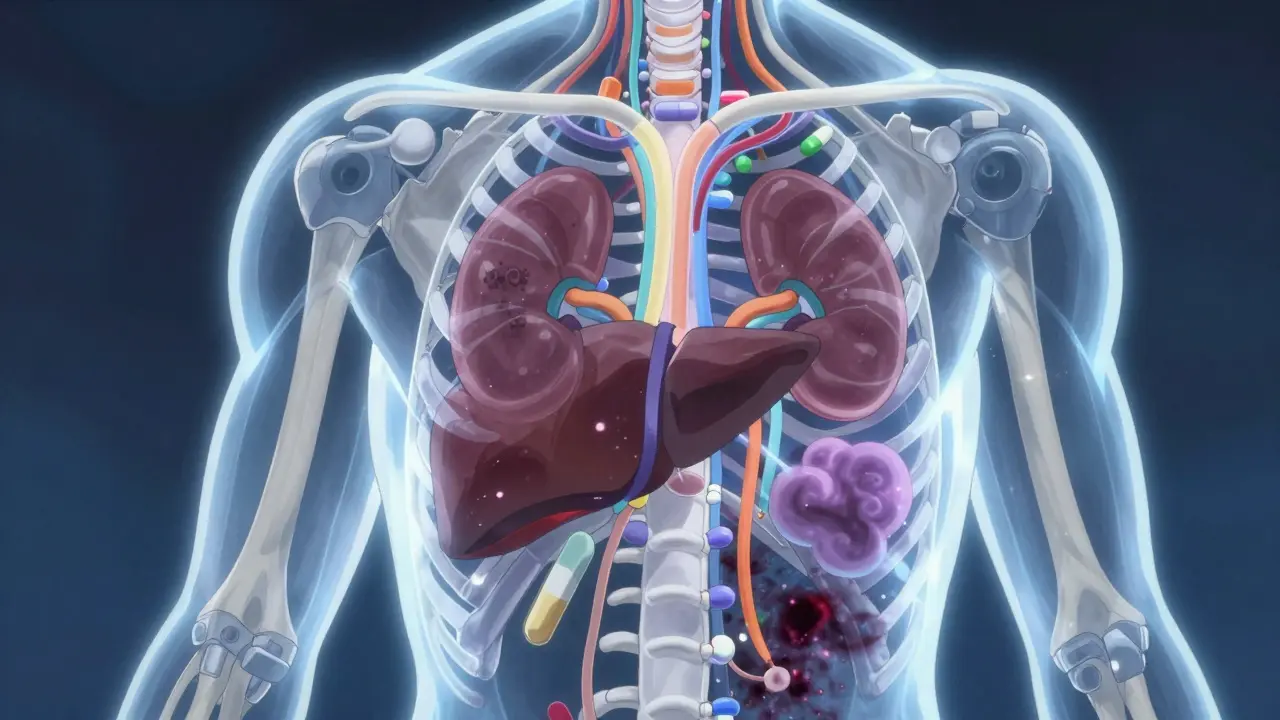
To understand why existing conditions increase drug risk, we have to look under the hood of human physiology. The term "disease-drug interaction" describes how a disease state directly affects a drug’s behavior in the body. It’s not about two drugs fighting each other; it’s about your illness changing the environment where the drug operates.
Consider liver disease. The liver is responsible for breaking down many common medications using enzymes called cytochrome P450. In patients with liver impairment, this enzyme activity can drop by 30% to 50%. When that happens, drugs stay in your system longer, building up to toxic levels even if you’re taking the recommended dose. Similarly, renal impairment reduces the glomerular filtration rate (GFR). If your GFR drops by 30% or more, your kidneys struggle to clear renally excreted drugs, leading to accumulation and potential toxicity.
Pharmacodynamic interactions add another layer of complexity. Pre-existing conditions can lower your threshold for adverse effects. For instance, a patient with Parkinson’s disease has a nervous system already primed for movement disorders. Introducing certain antipsychotics can trigger severe extrapyramidal symptoms much faster and more severely than in a healthy individual. These aren't rare edge cases; they represent the new normal for patients with multimorbidity.
The Polypharmacy Trap
If comorbidities raise the stakes, polypharmacy is the concurrent use of multiple medications by a single patient multiplies them. Patients with multiple chronic conditions rarely take just one pill. A cross-sectional study of elderly patients (aged 65 and older) revealed an 85% rate of multimorbidity. These individuals used an average of 4.26 medications daily. About 42% were on five or more drugs-a definition of high-risk polypharmacy.
This volume creates a dangerous synergy. In that same study, 47% of these elderly patients experienced potential drug-drug interactions. On average, each patient had 2.36 interactions per day. More alarmingly, 35.2% of these interactions were classified as "major," meaning they could cause permanent harm or be life-threatening. The relationship between the number of conditions and drug risk follows a dose-response pattern: as the burden of comorbidities increases, the likelihood of adverse events rises exponentially.
| Metric | Patients with Comorbidities | Patients without Comorbidities |
|---|---|---|
| ADR Prevalence | 19.6% | 7.6% |
| Odds Ratio for ADRs | 2.96 (High Risk) | 1.0 (Baseline) |
| Hospital Admission Frequency (due to ADRs) | 2.5x higher (with 3+ comorbidities) | Baseline |
| Common Symptoms | Weakness (36%), Dizziness (11.8%) | Dizziness (19.1%), Headache |
The data shows a distinct symptom profile for comorbid patients. While non-comorbid patients report dizziness most frequently, comorbid patients suffer significantly more from weakness (36% of cases), followed by dizziness, headache, nausea, and insomnia. Weakness is particularly concerning because it can lead to falls, fractures, and further hospitalization, creating a vicious cycle of declining health.
Specific High-Risk Scenarios
Not all comorbidities carry the same weight. Some conditions create particularly volatile environments for medication management. Cardiovascular diseases, for example, present dangerous interactions. Substances like alcohol, heroin, prescription stimulants, methamphetamine, and cocaine independently increase cardiovascular disease risk. When patients with underlying heart conditions are prescribed medications that also affect heart rate or blood pressure, the compounding effects can be catastrophic.
Chronic pain patients face unique vulnerabilities. Approximately 10% of these patients misuse prescription opioids. This creates a dangerous cycle where the treatment for pain becomes a risk factor for adverse outcomes, including respiratory depression and addiction. Furthermore, patients with substance use disorders often smoke tobacco (77-93% of those in treatment), which induces liver enzymes and alters the metabolism of many psychiatric and cardiovascular medications, reducing their efficacy or increasing toxicity.
Age compounds these risks. The Beers Criteria, a widely used guideline for identifying potentially inappropriate medication use in older adults, reveals that 45.7% of older patients receive at least one such medication. Female patients aged 75 and older are 2.93 times more likely to receive these risky prescriptions compared to younger counterparts. This highlights a systemic failure where age-related physiological changes are not adequately accounted for in prescribing habits.
The Evidence Gap in Clinical Trials
Here is a hard truth: the drugs you take may never have been tested on someone like you. Clinical trials are designed to isolate variables, so they often exclude patients with complex medical histories. Research indicates that 70% to 80% of elderly patients with multiple comorbidities are excluded from pivotal drug trials. This creates a massive evidence gap.
When a drug is approved, its safety profile is based on a "healthy" population that doesn’t reflect the real-world patient base. Doctors are then left to extrapolate safety data for patients who are fundamentally different from the trial participants. This is why real-world clinical data shows such alarming consequences. Hospital admissions due to adverse drug reactions are 2.5 times more frequent in patients with three or more comorbidities. In oncology settings, where 65% of patients have at least one comorbidity, drug interactions contribute to 30% of preventable adverse events, costing healthcare systems $1,200 to $2,500 per incident.

Mitigating the Risk: Practical Strategies
You cannot change your medical history, but you can manage the risks associated with it. The most effective intervention is a comprehensive medication review conducted by a clinical pharmacist. Studies show this simple step can reduce adverse drug reactions by 22% in comorbid patients. Don’t wait for an annual check-up; ask for a dedicated "medication reconciliation" appointment.
Technology is also stepping in to help. Electronic health record systems with integrated comorbidity-aware decision support have demonstrated a 35% reduction in potentially inappropriate prescribing for patients with renal impairment. Tools like the STOPP/START criteria (Screening Tool of Older Persons' Prescriptions / Screening Tool to Alert Doctors to Right Treatment) provide tailored deprescribing protocols. Implementing these tools has reduced ADR-related hospitalizations by 17% in multimorbid elderly patients.
However, barriers remain. Seventy-two percent of physicians report insufficient time for comprehensive medication reviews. Fragmented care is another major issue: 68% of patients with three or more comorbidities see five or more specialists, none of whom may have a complete view of the total medication load. As a patient, you must become the integrator of your own care. Keep an updated list of all medications, including over-the-counter drugs and supplements, and share it with every provider you visit.
The Future of Personalized Pharmacovigilance
The landscape is shifting toward more personalized approaches. The NIH launched the 'Comorbidity-Drug Interaction Knowledgebase' in 2024, aggregating evidence from 12 million patient records across 15 health systems. This database has already identified 217 novel high-risk combinations that were previously unrecognized. Machine learning models are now achieving 89% accuracy in predicting adverse drug reactions for specific comorbidity clusters, significantly outperforming traditional statistical methods.
Regulatory agencies are catching up. The FDA now requires comorbidity subgroup analyses in 78% of new drug applications, up from 42% in 2018. This means future drugs will come with clearer guidance on how they perform in patients with specific existing conditions. The American Medical Association’s 2025 update to the Comorbidity Assessment Tool incorporates dynamic drug-risk scoring that adjusts for real-time laboratory values, showing a 31% reduction in adverse events in pilot sites.
As populations age, multimorbidity will become the norm rather than the exception. Projections indicate that 90% of adults over 65 will have two or more chronic conditions by 2030. Addressing the intersection of comorbidities and drug risk is no longer a niche concern-it is central to patient safety and healthcare sustainability.
What are the most common side effects in patients with comorbidities?
The most predominant symptoms observed in comorbid patients include weakness (36% of cases), dizziness (11.8%), headache (7.3%), nausea (4.9%), vomiting (4.0%), and insomnia (2.9%). Weakness is particularly significant as it can lead to secondary complications like falls.
How do liver and kidney diseases affect medication safety?
Liver disease can reduce cytochrome P450 enzyme activity by 30-50%, causing drugs to accumulate in the body. Kidney disease reduces the glomerular filtration rate (GFR); a reduction of 30% or more significantly impairs the clearance of renally excreted drugs, increasing the risk of toxicity.
Why are older adults at higher risk for adverse drug reactions?
Older adults often have multiple comorbidities and engage in polypharmacy (taking 5+ medications). Additionally, 70-80% of elderly patients with multiple comorbidities are excluded from clinical trials, meaning there is less evidence regarding drug safety for their specific physiological profiles. Age-related declines in organ function also slow drug metabolism.
What is the Beers Criteria?
The Beers Criteria is a clinical guideline used to identify potentially inappropriate medication use in older adults. It helps healthcare providers avoid drugs that pose disproportionate risks to elderly patients, such as those causing confusion, falls, or severe metabolic disturbances.
How can I protect myself from drug interactions if I have multiple conditions?
Request a comprehensive medication review from a clinical pharmacist. Maintain an updated list of all medications, including over-the-counter drugs and supplements. Share this list with every specialist you visit. Ask your doctor if electronic decision-support tools have flagged any interactions in your chart.
Are clinical trials representative of patients with comorbidities?
No. Research shows that 70-80% of elderly patients with multiple comorbidities are excluded from pivotal drug trials. This creates an evidence gap, as safety data is primarily derived from healthier populations, making real-world application riskier for complex patients.
What is polypharmacy?
Polypharmacy refers to the concurrent use of multiple medications by a single patient. It is often defined as taking five or more medications daily. Polypharmacy significantly increases the risk of drug-drug interactions and adverse drug reactions, especially in patients with comorbidities.