
When a stroke happens, it doesn’t just stop your body in its tracks-it rewires your life. But recovery isn’t just about waiting for things to get better on their own. The truth is, the brain has an incredible ability to heal itself, and stroke rehabilitation is what unlocks that potential. Without targeted therapy, many people lose movement, speech, or independence for good. With it, they walk again, speak clearly, and return to the things they love. This isn’t magic. It’s science.
How the Brain Heals After Stroke
Your brain isn’t a static organ. Even after damage from a stroke, it doesn’t just sit there. It rewires. This process is called neuroplasticity. Think of it like a road system where a bridge got destroyed. Traffic can’t flow the same way, but new detours form. In the brain, undamaged areas take over functions lost when other parts were injured. Studies using functional MRI show this reorganization happens within just 2-4 weeks of starting therapy.
It’s not about fixing the damaged tissue. It’s about teaching the rest of the brain to handle the work. That’s why repetition matters so much. If you want to move your arm again, you don’t just hope it happens-you practice the exact motion, over and over. Every rep builds a new neural pathway. The more you do it, the stronger that path becomes.
The Three Phases of Recovery
Recovery doesn’t happen in one big leap. It unfolds in stages, and each one needs a different kind of focus.
Recovery/Natural Healing (days to weeks): Right after a stroke, swelling goes down, and some movement returns on its own. This is the window to act fast. Early mobilization-even sitting up or standing with help-cuts the risk of muscle stiffness and blood clots. The Chartered Society of Physiotherapy found that starting therapy within 24 hours improves functional outcomes by 35% compared to waiting.
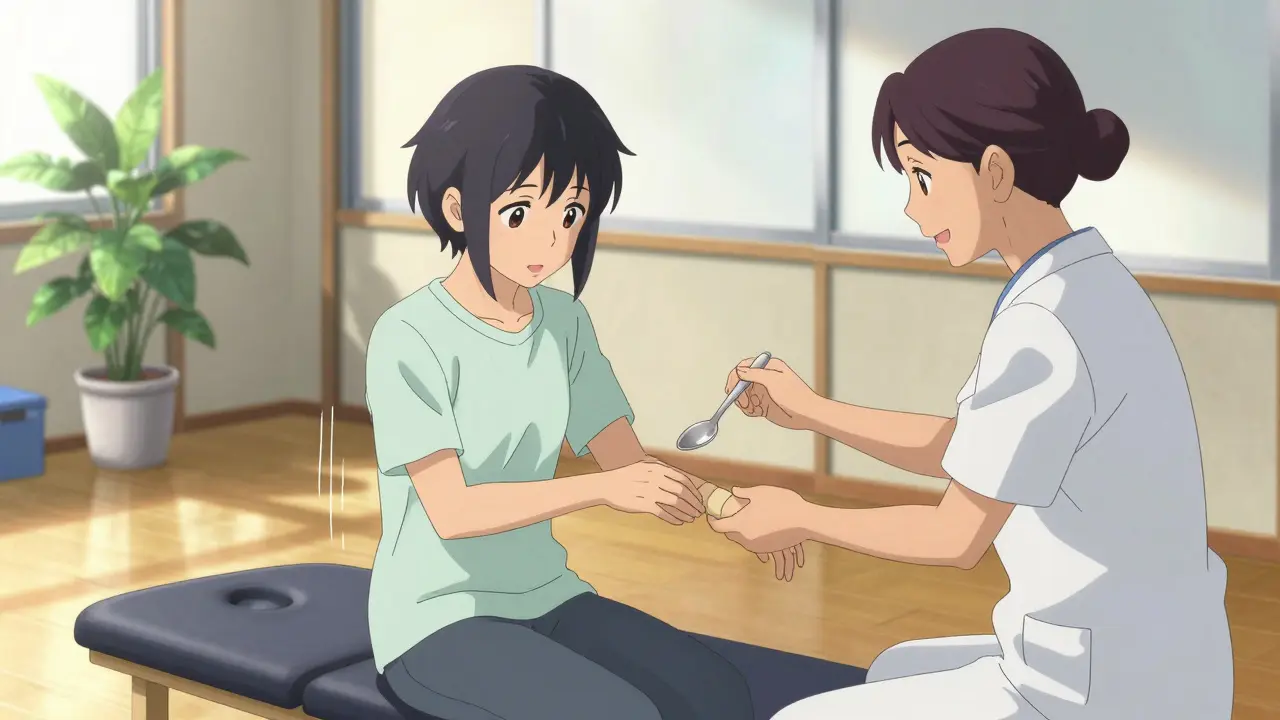
Retraining (weeks to months): This is where therapy gets intense. Physical therapists guide patients through motor-skill drills. Occupational therapists help relearn daily tasks like brushing teeth or buttoning a shirt. Speech-language pathologists work on speaking, swallowing, and understanding language. The key here is repetition with purpose. A patient might practice lifting a spoon 50 times a day. Not because it’s hard, but because each time, the brain strengthens the connection between intention and movement.
Adaptation (months to years): Not everyone regains full function. And that’s okay. Adaptation is about living well with what’s left. This phase includes modifying the home-adding grab bars, lowering kitchen counters, installing a shower chair. It’s also about mindset. Depression affects 30-35% of stroke survivors. Counseling and peer support groups help people adjust to a new normal.
The Team Behind the Recovery
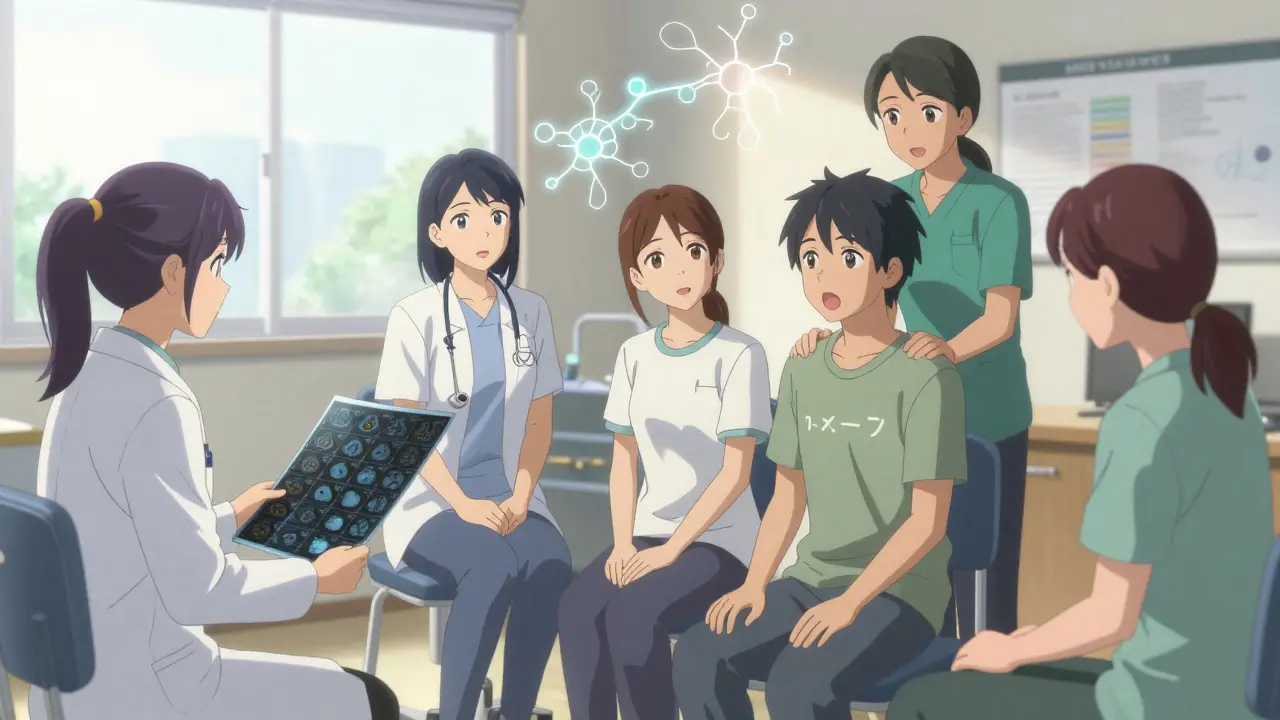
No single therapist can do it all. Recovery needs a crew. The American Stroke Association’s 2016 guidelines make it clear: the best outcomes happen when a team works together.
- Physiatrists lead the medical side, managing pain, spasticity, and medications.
- Physical therapists focus on walking, balance, and strength. Constraint-induced therapy-where the good arm is strapped down so the affected one must be used-has shown 30% better motor gains than standard care.
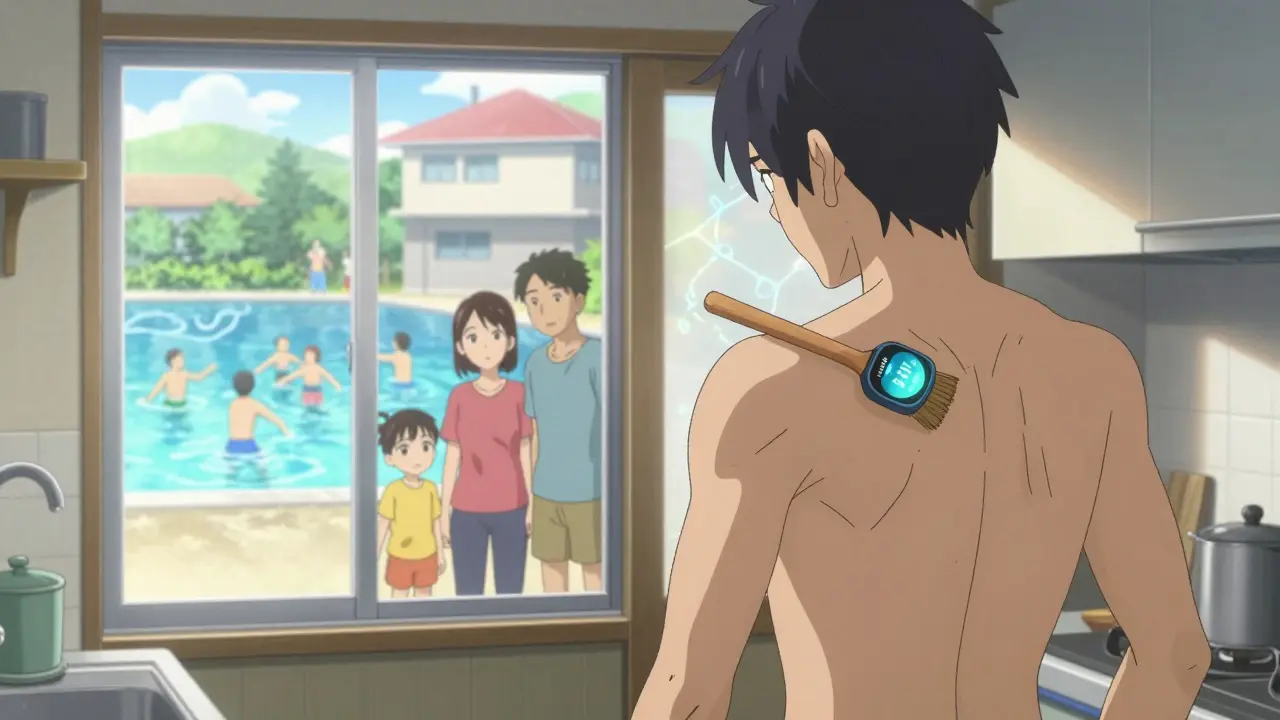
- Occupational therapists tackle daily living: dressing, cooking, bathing. They teach tricks, like using one hand to button a shirt or a long-handled brush to reach your back.
- Speech-language pathologists help with aphasia, swallowing issues, and memory problems. Techniques like melodic intonation therapy (singing phrases to trigger speech) have helped people talk again after years of silence.
- Psychologists address emotional health. Anxiety and depression can derail progress. Therapy here isn’t optional-it’s essential.
- Social workers connect families to resources: home care, financial aid, transportation.
Facilities with structured team meetings see 22% better functional outcomes. Communication between these experts isn’t just helpful-it’s the difference between a slow recovery and a real one.
Therapy That Works
Not all therapy is created equal. Some methods have decades of research backing them up.
- Constraint-Induced Movement Therapy: Restraining the unaffected limb for 90% of waking hours forces the brain to rely on the weaker side. Mayo Clinic studies show this leads to 30% greater improvement in arm and hand function.
- Functional Electrical Stimulation (FES): Small electrical pulses stimulate weakened muscles in the wrist or hand. This isn’t just tingle-it builds real strength. Patients gain 25-45% more grip strength after 12 weeks.
- Robotic Devices: Machines like the Lokomat help patients walk with support. They move the legs through perfect motion patterns, hundreds of times a session. Studies show 50% greater improvement in walking speed than traditional therapy.
- Virtual Reality: Patients play games that require reaching, grasping, or stepping. The brain thinks it’s in a real environment. This boosts upper limb function by 28% compared to standard exercises.
- Wireless Activity Monitors: Simple pedometers or smartwatches that track steps. They don’t just measure-they motivate. Users increase daily steps by 32% just by seeing their progress.
These aren’t gimmicks. They’re tools that make therapy more effective, more engaging, and more measurable.
Timing and Intensity Matter
You can’t rush recovery, but you can’t wait either. The American Stroke Association recommends 3 hours of therapy, 5 days a week, for patients who are medically stable. That’s not a suggestion-it’s the minimum threshold for meaningful progress.
Intensity isn’t about pain. It’s about repetition and challenge. If you’re doing 10 reps of a movement, you’re not pushing hard enough. Aim for 50-100. If you’re not sweating, you’re not learning.
Balance training is critical too. Sixty percent of stroke survivors struggle with balance. That means falls. That means broken hips. That means hospital readmissions. Structured balance drills-standing on one foot, shifting weight, walking on uneven surfaces-cut fall risk by nearly half.
And don’t forget the mental side. Motivation accounts for up to 40% of recovery success. If someone doesn’t believe they can improve, they won’t. Family involvement increases adherence by 37%. A loved one sitting in therapy, cheering on small wins, makes all the difference.
What Happens After the Clinic?
Most stroke survivors leave rehab after 2-6 weeks. But recovery doesn’t stop there. Seventy percent need ongoing therapy. That’s where community programs and telerehabilitation come in.
Telerehabilitation-therapy done via video calls-has been shown to be 85% as effective as in-person sessions for many tasks. Patients do exercises at home with real-time feedback from a therapist. It’s not perfect, but it’s accessible, affordable, and keeps progress going.
Community programs offer group classes: water aerobics, yoga for stroke survivors, art therapy. These aren’t just exercise-they’re lifelines. Social connection reduces depression, keeps people active, and reminds them they’re not alone.
What Holds Recovery Back
Not everyone recovers well. Why?
- Delayed start: Waiting too long to begin therapy means muscles tighten, joints stiffen, and the brain loses momentum.
- Lack of intensity: Therapy that’s too light doesn’t challenge the brain enough to rewire.
- Isolation: No family support? No peer group? Recovery slows. Depression creeps in.
- Ignoring secondary issues: High blood pressure, poor diet, inactivity-these aren’t side notes. They’re roadblocks.
Contractures (permanent muscle shortening) affect 30-50% of those who don’t get early range-of-motion exercises. Depression hits 1 in 3. Both are preventable.
What’s Next in Recovery?
Science is moving fast. Transcranial magnetic stimulation (TMS)-a non-invasive brain stimulation technique-adds 15-20% more motor recovery when paired with therapy. Researchers are testing drugs that boost brain-derived neurotrophic factor (BDNF), a protein that helps neurons grow. AI is being trained to personalize rehab plans based on brain scans and movement patterns.
One thing is clear: the future of recovery isn’t just more therapy. It’s smarter therapy.
Real Recovery, Real Life
Recovery after a stroke isn’t about going back to who you were. It’s about becoming someone new-with new strengths, new routines, and new ways of living. Some people walk again. Others learn to write with their non-dominant hand. Some find joy in painting, even if they can’t hold a brush the same way.
It’s messy. It’s hard. But it’s possible. And it starts with one decision: don’t wait. Start moving. Start trying. Start believing-even when it feels impossible.



8 Comments
you know what really gets me is how people just sit around waiting for god to fix their stroke recovery like its some kinda miracle thing
its not magic its science and if you dont do the reps you deserve to be stuck
my cousin waited 3 weeks to start PT and now she cant hold a coffee cup
stop being lazy and show up
its not rocket science
i just want to say how much this post helped me
my mom had a stroke last year and we were lost until we found this exact breakdown
the part about adaptation really hit home-we started lowering the kitchen counter and now she makes her own coffee again
thank you for writing this with so much heart
OMG THIS IS SO TRUE I CRIED READING THIS
my husband did constraint-induced therapy and we thought he was never gonna move his hand again
but after 6 weeks of doing 80 reps of picking up spoons every single day-he started holding my hand during movies
not perfectly, not fast, but he held it
and that was the moment i knew neuroplasticity was real
also i want to shout out occupational therapists-they are the unsung heroes who teach you how to button a shirt with one hand like its a ninja move
they deserve a national holiday
While I commend the comprehensive nature of this exposition, I must formally express my profound concern regarding the omission of any reference to the socioeconomic determinants of rehabilitation access.
It is not merely a question of intensity or repetition, but of equitable distribution of resources.
In underserved communities, telerehabilitation is often inaccessible due to infrastructural deficits.
To frame recovery as solely a function of individual effort is to engage in a dangerous form of medical individualism.
One cannot optimize neuroplasticity if one lacks transportation, internet, or insurance.
Kindly consider expanding the scope of your analysis to include structural inequity as a primary barrier to recovery.
ok but let’s be real-neuroplasticity is just the brain’s way of doing a system restore after a crash
you think your brain is some genius rebuilding roads? nah
it’s just the backup servers taking over because the main one died
and honestly? most people don’t even get 3 hours of therapy a day
they get 20 minutes on a treadmill while the insurance company says ‘that’s enough’
and then they wonder why grandma can’t walk
its not about willpower
its about who’s paying for the damn robot
you mentioned robotic devices and vr but didn’t touch on cost
most people can’t afford that stuff
the real therapy is the guy in the community center who does leg lifts with a resistance band and a plastic water bottle
he’s not flashy
but he shows up every day
and that’s what matters
not the fancy machines
just consistency
just wanted to say thank you
my dad started telerehab last month
he’s 78 and didn’t think he could do it
now he does his exercises every morning while eating toast
he says it feels like he’s talking to a coach instead of staring at a screen
small wins
but they add up
and i’m so proud of him
thank you for making this feel possible
my sister had a stroke and we thought she’d never talk again
then we found melodic intonation therapy
she started singing old gospel songs
and one day she sang ‘Amazing Grace’ out loud
for the first time in 18 months
it wasn’t perfect
but it was her
and it broke me open
thank you for including that
it matters
Write a comment