
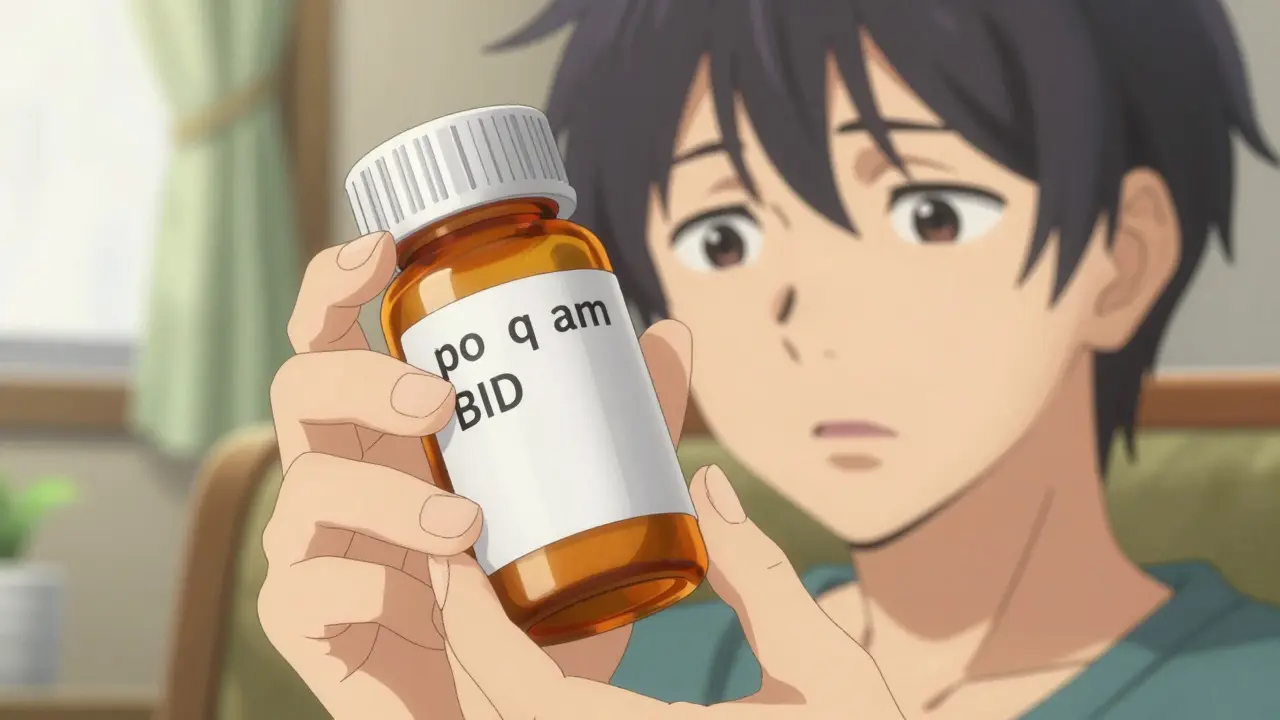
You’ve just left the pharmacy or doctor's office, you look down at your prescription bottle, and you have no idea what "po q am" or "BID" means. You aren't alone. Confusing medication instructions are a massive patient safety risk. In the United States, unclear directions contribute to roughly 1.5 million medication-related injuries every year. Whether it's a weird abbreviation, a vague "take as needed" note, or instructions that seem to contradict what the pharmacist told you, guessing is never an option. Your health depends on getting the dose right, and the only way to do that is to push for absolute clarity before the first dose hits your system.
What makes medication instructions confusing?
Most of the time, the confusion comes from a gap between how doctors write and how patients read. Many providers use medical shorthand that makes sense to them but looks like a secret code to everyone else. For example, Medication Instructions is the set of directions provided by a healthcare provider or pharmacist detailing the dose, frequency, and method of administration of a drug. When these directions use abbreviations like "q.d." for daily, it creates a risk of error.
The Institute for Safe Medication Practices (ISMP) has actually banned several of these shortcuts. They insist on using Arabic numerals (5 instead of V) and writing out "daily" instead of "QD." Another common tripwire is "as needed" dosing. This is dangerously vague. You need to know exactly what symptom triggers the dose, the maximum number of pills you can take in 24 hours, and the minimum amount of time you must wait between doses. Without these specifics, "as needed" can quickly lead to an overdose or ineffective treatment.
How to spot red flags on your prescription
Before you take your medicine, do a quick audit of the label. If you see any of the following, it's time to call your provider or pharmacist for a breakdown:
- Vague Timing: "Twice daily" can be interpreted as "whenever I remember," but for many drugs, it actually means as close to 12 hours apart as possible (e.g., 8 am and 8 pm).
- Ambiguous Abbreviations: If you see letters like "IN" (which could be intranasal) or "IM" (intramuscular), don't guess. A mistake here could mean the difference between a nasal spray and an injection.
- Conflicting Info: If the printed label says one thing, but the Medication Guide (the FDA-mandated paper insert for high-risk drugs) says another, you have a major red flag.
- Dosing Formulas: Anything involving "mg/kg/d" can be confusing. Does the "d" stand for day or dose? You need a concrete number of milligrams per dose.

The right way to ask for clarification
When you call your doctor or pharmacist, don't just say "I'm confused." Be specific about what isn't making sense. This helps the provider give you a precise answer rather than a general repetition of the instructions. Use these specific prompts to get the a answers you need:
- "What is the exact goal of this medication?" Knowing the purpose helps you understand why the timing matters. For instance, cholesterol-lowering drugs are often taken at bedtime because your body produces more cholesterol overnight.
- "Can you translate these abbreviations into plain English?" If you see "po q am," ask them to confirm it means "by mouth every morning."
- "What is the maximum dose I can take in one day?" This is critical for "as needed" medications to prevent toxicity.
- "What happens if I miss a dose?" Different drugs have different "catch-up" protocols; some should be taken immediately, while others require you to skip the missed dose entirely.
| Confusing Term | What it likely means | Clear Alternative |
|---|---|---|
| BID / b.i.d. | Twice a day | Take two times daily (e.g., 8am and 8pm) |
| PO | By mouth | Swallow with water |
| q am | Every morning | Take every morning |
| PRN | As needed | Take only when [Symptom] occurs, max [X] doses/day |

Dealing with manufacturer inconsistencies
Here is a weird quirk of the pharmaceutical world: different manufacturers of the same generic drug sometimes provide slightly different instructions. The National Institutes of Health (NIH) has noted that these inconsistencies can impact patient health if not addressed. If you switch brands and notice the instructions on your new bottle differ from your old one, don't just assume the new one is "updated."
Ask your pharmacist to compare the two. They can determine if the difference is trivial or if it requires a change in how you take the medication. This is especially important for high-risk medications like opioids or certain contraceptives, where precise timing and dosing are non-negotiable.
Practical tools to prevent medication errors
Once you've gotten your clarification, the next challenge is actually following the plan. Human memory is faulty, and stress makes it worse. To bridge the gap between "understanding" and "doing," use these strategies:
- Set Digital Reminders: The CDC suggests using phone timers or alarm apps. Don't rely on "I'll remember when I eat breakfast," as routines often shift.
- The "Match Test": When you pick up a new refill, compare the new label to your original prescription copy or your previous bottle. If the dose or frequency has changed and you weren't told about it, stop and ask why.
- Use a Medication Log: For complex schedules (like taking one tab for a week, then switching to twice daily), write a calendar. Crossing off each dose visually prevents the "Did I already take that?" panic.
- Request Electronic Guides: While the FDA requires paper Medication Guides for high-risk drugs, you can often request electronic versions that are easier to search and read on a screen.
Is it normal for different pharmacies to have different instructions for the same drug?
It can happen if pharmacies use different software or if the prescribing doctor's shorthand is interpreted differently. However, it isn't "normal" in a way that should be ignored. If you notice a discrepancy between two pharmacies, you must call the prescribing doctor to confirm the definitive dose.
What should I do if I can't reach my doctor but the instructions are confusing?
Your pharmacist is your best immediate resource. Pharmacists are experts in pharmacology and can often decode a doctor's shorthand or identify if a dose seems clinically inappropriate. If you are still unsure, do not take the medication until you get a clear answer.
Why are some medications taken specifically at bedtime?
Timing often depends on how the body functions. For example, because the body produces the most cholesterol overnight, taking cholesterol-lowering meds at bedtime maximizes their effectiveness. Other drugs may be timed to coincide with certain hormone peaks or to reduce side effects like drowsiness.
What is a Medication Guide and do I actually need to read it?
A Medication Guide is an FDA-mandated handout for drugs that carry significant risks. Yes, you should read it-especially the sections on serious adverse reactions and specific administration rules. It contains safety information that might not fit on the small pharmacy label.
How do I know if I'm taking a 'high-risk' medication?
Generally, if the FDA requires a formal Medication Guide (like for opioids, isotretinoin, or certain oral contraceptives), the drug is considered high-risk. However, any drug with a narrow therapeutic index (where a small dose change can be dangerous) should be treated with the same level of caution.





8 Comments
Omg this is so helpful! 🌟 I actually always use a pill organizer because honestly who can remember everything? 💊 Just a little tip, if you're using those generic ones, always double check the day of the week because it's so easy to accidentally skip a day if you start on the wrong one! 🌈✨
Absolutely ridiculous that we have to decode riddles just to take some damn pills in the greatest country on earth :( just write it in plain English you bunch of overpaid pencil pushers! 🙄
Ugh, I can't even imagine being this confused by basic medical shorthand. Like, really? 🙄 I’ve always found it quite intuitive, but I guess some people just aren't wired for it 💅✨
wow yeah because doctors are just so great at communicating... truly a miracle of modern medicine lol 🙄
I love this!! it is such a great reminder to advocate for ourselves and our health!! lets all just be brave and ask those questions until we get it right!! you got this everyone!! ☀️
The emphasis on verifying the maximum daily dose for PRN medications is particularly important for patient safety. In my experience, providing a written schedule to the patient can significantly reduce the cognitive load and prevent potential errors in administration.
totally agree. pharmacists are lifesavers
It's probably just that the systems are outdated, though I suppose we should all just try to be more patient with the staff who are just following the protocols they were given.
Write a comment