
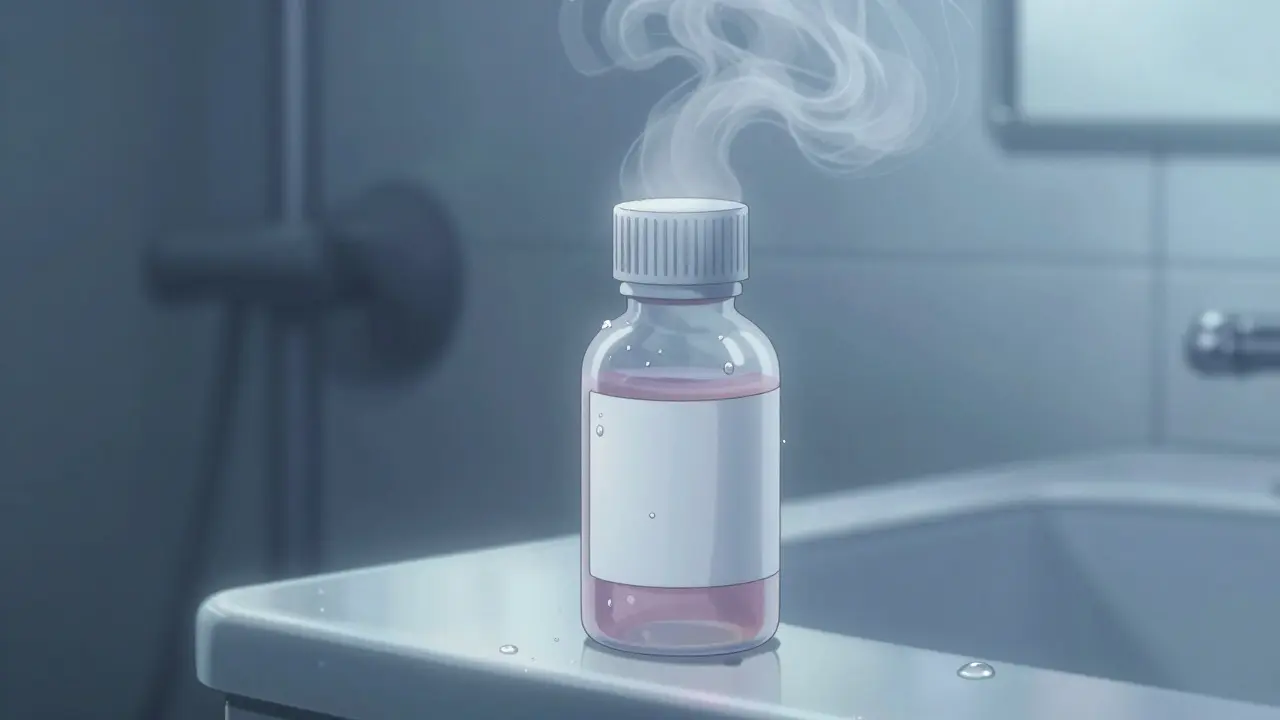
Ever opened a pill bottle only to find your tablets have become sticky, changed color, or developed a strange smell? You aren't alone. Moisture is one of the biggest enemies of medication stability. When humidity gets into your meds, it doesn't just change how they look; it can trigger a process called hydrolysis. This is where water molecules break down the active ingredients, potentially making your medicine less effective or, in some cases, creating irritating byproducts. For example, aspirin can break down into vinegar and salicylic acid when exposed to moisture, which can cause stomach irritation.
The goal is simple: keep the water out. Whether you are a patient managing a chronic condition or someone curious about how pharmacy products are made, understanding moisture damage to pills is key to ensuring your treatment actually works. While manufacturers do a lot of the heavy lifting with coatings and packaging, there are specific things you can do to protect your supply.
The Hidden Dangers of Humidity
Moisture damage isn't just about a few damp tablets. It's a chemical reaction. In the pharma world, this often happens through oxidation or hydrolysis. When Active Pharmaceutical Ingredients (APIs)-the actual medicine in the pill-interact with water vapor, the chemical structure changes. This degradation means you might be taking a dose that is significantly weaker than what the doctor prescribed.
Certain vitamins and medications are far more sensitive than others. Vitamin C is a prime example; it reacts quickly with oxygen, a process that moisture accelerates. If you live in a humid climate, like a tropical region or a coastal city, your medications are under constant attack from the air every time you open the bottle.
How Manufacturers Build Your Defense
You might notice that some pills have a shiny, hard shell while others feel more porous. This is no accident. Manufacturers use several layers of protection to keep meds stable.
Advanced Film Coatings
Film Coating is a thin polymer layer applied to the tablet. Not all coatings are equal. For a long time, many used HPMC (hydroxypropyl methylcellulose), but that's like using a thin raincoat. Modern high-performance coatings use Polyvinyl Alcohol (PVA). PVA-based coatings, like those found in Opadry systems, act more like a waterproof seal. They provide roughly three times the protection of older coatings, significantly lowering the water vapor transmission rate.
The Role of Desiccants
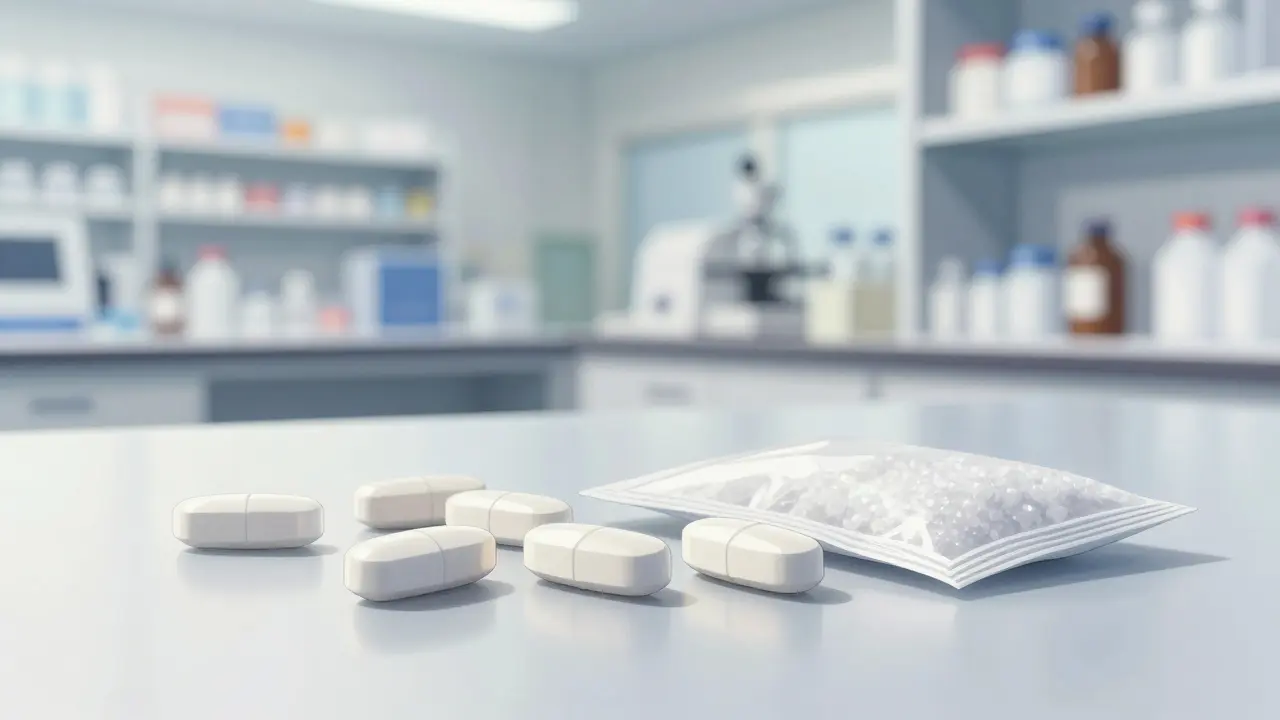
Have you ever seen a small white packet or a hard plastic cylinder inside your medicine bottle? That's a desiccant. The industry gold standard is Silica Gel. These aren't just fillers; they are active moisture scavengers. A high-quality silica gel pack can absorb up to 40% of its own weight in water. This is critical because every time you open your bottle to take a pill, you let in a "headspace replacement" of humid air. In a bottle of 500 pills, you're doing this 250 times if you take two pills a day. Without a desiccant, that moisture just sits there and attacks the pills.
Packaging Material
The bottle itself matters. Most pharmacies use High-Density Polyethylene (HDPE) or polypropylene. These plastics are great at stopping liquid water from leaking in, but they aren't perfect barriers against water vapor. That's why the combination of a PVA coating, an HDPE bottle, and a silica gel pack is the "triple threat" of moisture protection.
| Method | Primary Function | Effectiveness | Main Weakness |
|---|---|---|---|
| HPMC Coating | Basic barrier | Moderate | High vapor permeability |
| PVA Coating | Advanced seal | High | Higher manufacturing cost |
| Silica Gel | Active absorption | Very High | Limited capacity (fills up) |
| HDPE Bottles | Physical shell | Moderate | Allows some vapor ingress |
Common Storage Mistakes to Avoid
Even the best-manufactured pill can be ruined by where you keep it. Many of us default to the bathroom medicine cabinet because it's convenient. This is actually the worst place for your meds. The steam from your shower creates a high-humidity microclimate that penetrates plastic bottles over time.
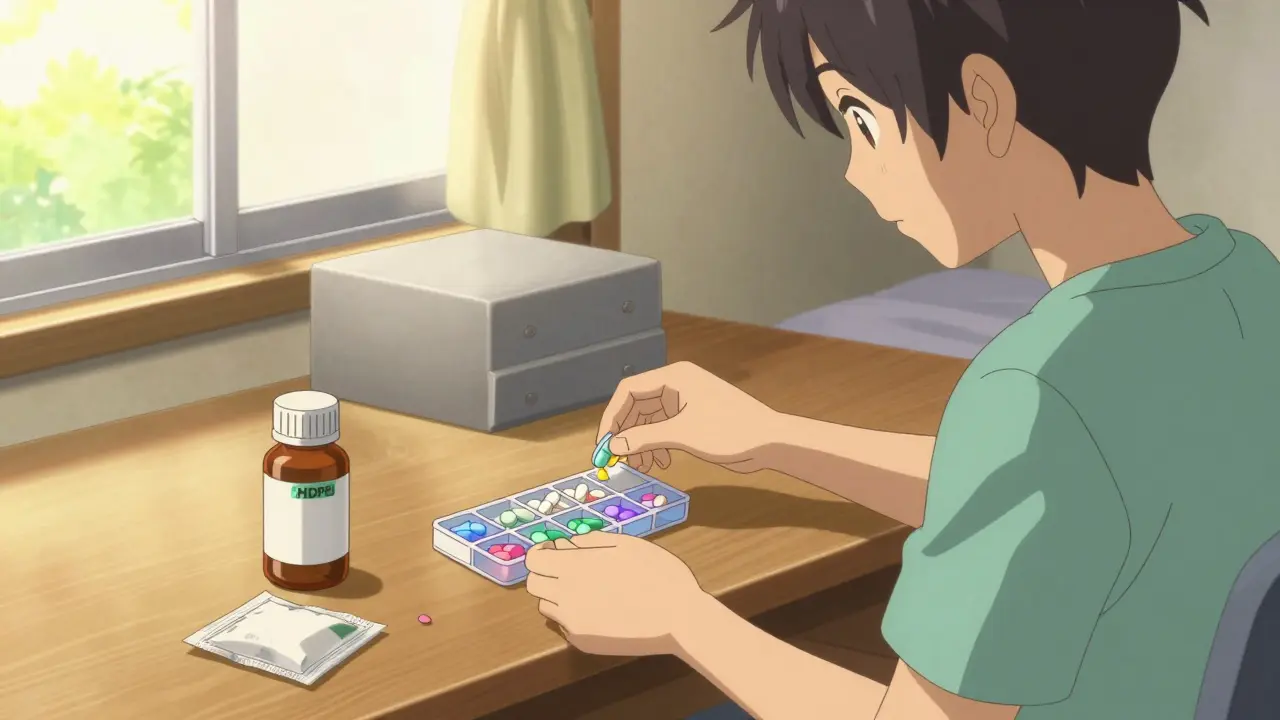
Another mistake is transferring medications into generic pill organizers or "day-of-the-week" sorters. While this helps with adherence, you are removing the pills from their protective environment-specifically, you're ditching the desiccant pack. If you use a pill organizer, only fill it for a few days at a time rather than a whole month, and keep the organizer in a cool, dry area.
Practical Tips for Home Preservation
If you're worried about your medications degrading, follow these simple rules of thumb:
- Keep the desiccant: Never throw away the small silica packet or the plastic canister inside your bottle. Leave it in there until the bottle is empty.
- Tighten the cap: It sounds obvious, but a loose cap is an open door for humidity. Ensure the seal is tight after every use.
- Avoid the "Steam Zone": Move your medications to a bedroom drawer or a kitchen cabinet far from the stove or sink.
- Watch for signs of damage: If your capsules feel soft or sticky, or if your tablets are crumbling or changing color, contact your pharmacist. Don't guess if they are still safe.
The Future of Pill Protection
The industry is moving toward even smarter solutions. We are seeing the rise of "active moisture scavenging systems" where the protection is built directly into the tablet's chemistry, not just the coating. There are also developments in color-changing labels that will tell you at a glance if the seal has been compromised and moisture has entered the bottle. This takes the guesswork out of whether your medicine is still potent.
Can I replace a lost desiccant packet with a store-bought one?
It is generally not recommended. Pharmaceutical-grade desiccants are specifically tested for purity and compatibility with medication. Store-bought packets might contain additives or be wrapped in materials that could react with your medicine. If you lose your desiccant, the best move is to keep the bottle tightly sealed and store it in the driest place possible.
Does refrigeration help prevent moisture damage?
Not necessarily. While some meds require refrigeration for temperature stability, fridges can actually be quite humid. If you must store a medication in the fridge, keep it in a tightly sealed, moisture-proof container to prevent the cold, damp air from affecting the tablets.
How do I know if my pills have moisture damage?
Look for physical changes: capsules may become soft, sticky, or swell; tablets may crack, change color, or develop a "vinegar" smell (common with aspirin). If the pills clump together, it's a clear sign that moisture has entered the bottle.
Are all pill coatings designed to block moisture?
No. Some coatings are only meant to mask a bad taste or make the pill easier to swallow. Only specific moisture-barrier coatings, like those based on PVA, are designed to significantly block water vapor.
Why are some medications in blister packs instead of bottles?
Blister packs provide individual protection for each dose. This prevents the "headspace replacement" problem found in bottles, where every opening exposes the entire batch to humidity. For extremely moisture-sensitive drugs, aluminum foil-foil blisters are often the gold standard.
What to do if you suspect damage
If you notice your medication looks or feels "off," don't risk taking it. Degraded medication can be ineffective, meaning your condition isn't being treated. In some cases, the chemical breakdown can create impurities that cause stomach upset or other side effects. Your first step should be to call your pharmacist. They can tell you if the specific drug you're taking is highly hygroscopic (moisture-attracting) and whether the physical changes you see are a sign of failure.
For those using daily pill organizers, try shifting to a weekly rotation where you only move a few days' worth of meds at a time. This limits the window of exposure and keeps the bulk of your medication safe inside the original, desiccant-protected bottle.



15 Comments
Blister packs are objectively superior for stability. If you have a choice between a bottle and foil-foil blisters for high-hygroscopicity meds, always go with the blisters to avoid that headspace air exchange.
Omg i always kept mine in the bathroom! gotta move them now!! thnx!
Funny how they tell us to trust these "pharmaceutical grade" desiccants. I bet these chemicals are just another way for the big pharma conglomerates to keep us dependent on their patented delivery systems while they control the supply chain. It is all about the profit margin and keeping the masses docile through chemical degradation and controlled potency. Wake up people, the real medicine isn't found in a PVA-coated pill manufactured in a lab!
This is a great breakdown of the kinetics involved here. Understanding the hydrolysis pathway is key for anyone managing a complex regimen. It's all about maintaining that chemical equilibrium by minimizing the vapor pressure inside the HDPE vessel.
Imagine actually believing a plastic bottle can save your meds when the entire healthcare system is a joke anyway :'(’ the irony of worrying about a tiny silica packet while the actual drugs are probably placebo anyway lol
It's honestly fascinating how people just blindly follow the "rules" of storage without considering the existential nature of stability. We obsess over the PVA coating as if it's some magical shield, but in reality, we are just delaying the inevitable entropy of every organic molecule we put in our bodies. The obsession with the "perfect" environment is just a manifestation of our fear of decay, yet we forget that the body itself is a humid, chaotic environment that will break down the drug regardless of whether it was stored in a bedroom drawer or a fancy vault. We treat the pill like a sacred relic, but it's just chemistry meeting biology in a slow-motion collision of degradation and absorption, and honestly, the anxiety over a slightly sticky capsule is just a distraction from the larger realization that we are all just chemical reactions waiting to happen.
I never knew about the vinegar smell with aspirin!!! That is so wild!!!!
I work in a pharmacy and we see this all the time with the pill organizers. People just dump a month's worth in there and then wonder why their meds aren't working as well. Its way better to just fill it weekly like the post says!
USA made meds are the best in the world and we should be proud of our tech! 🇺🇸🇺🇸 Just keep them dry and stay strong!! 💪✨
The molecular stability of APIs is frequently compromised by atmospheric moisture ingress... this is exactly why the stoichiometric balance of the desiccant is paramount!!! The industry's reliance on HDPE is an outdated paradigm that ignores the permeability of water vapor molecules!!!
One finds the lack of basic chemical literacy in the general public quite distressing. It is simply elementary that humidity accelerates degradation
STOP KEEPING YOUR MEDS IN THE BATHROOM RIGHT NOW! IT IS STUPID AND DANGEROUS!
It's so helpful to have these tips in one place. It makes it feel a lot more manageable for everyone.
The primacie of Americann manufacturing standards ensureth that our medcations are the most robust in the global market. It is imperative that one adhere to these storage guidelines.
I agree with the advice on pill organizers. Maybe suggest using a small airtight container for the organizer itself if people really need to prep for the whole month.
Write a comment