

Green Tea & Warfarin Safety Calculator
Calculate Your Safe Green Tea Intake
Based on medical guidelines from the National Blood Clot Alliance
Safe Consumption
Your intake is within recommended limits.
Recommended: 3 cups (720 mL) or less daily.
Continue with consistent intake and monitor INR as usual.
When you're on warfarin, your life revolves around one number: your INR. It tells you if your blood is clotting too fast or too slow. But what you drink - especially green tea - can quietly mess with that number. You might think a cup or two is harmless. And for most people, it is. But if you're drinking green tea by the gallon, or switching to matcha daily, your INR could drop - fast. And that’s not just a lab result. It’s a risk of stroke or clotting.
How Warfarin Works - And Why Vitamin K Matters
Warfarin, sold as Coumadin or Jantoven, doesn’t thin your blood like water. It blocks vitamin K from helping your body make clotting factors. Without enough vitamin K, your blood takes longer to clot. That’s why your doctor checks your INR - a standardized test that shows how long your blood takes to clot. For most people on warfarin, the target range is 2.0 to 3.5. Go below 2.0? Your risk of clots goes up. Go above 3.5? You could bleed internally without warning.
Now, vitamin K is everywhere. Spinach, kale, broccoli - they’re packed with it. But here’s the twist: you don’t need to avoid vitamin K. You need to keep it consistent. One day you eat a big salad, the next day you eat plain rice? Your INR will bounce around. That’s dangerous. The goal isn’t to eliminate vitamin K. It’s to keep your intake steady.
Green Tea Has Vitamin K - But Not Like You Think
Green tea comes from the same plant as black tea: Camellia sinensis. The leaves themselves? Loaded with vitamin K - about 1,428 micrograms per 100 grams. But that’s not what you drink. When you brew tea, most of the vitamin K stays in the leaves. The brewed tea? Just 0.03 micrograms per 100 grams. That’s tiny. So why do people have problems?
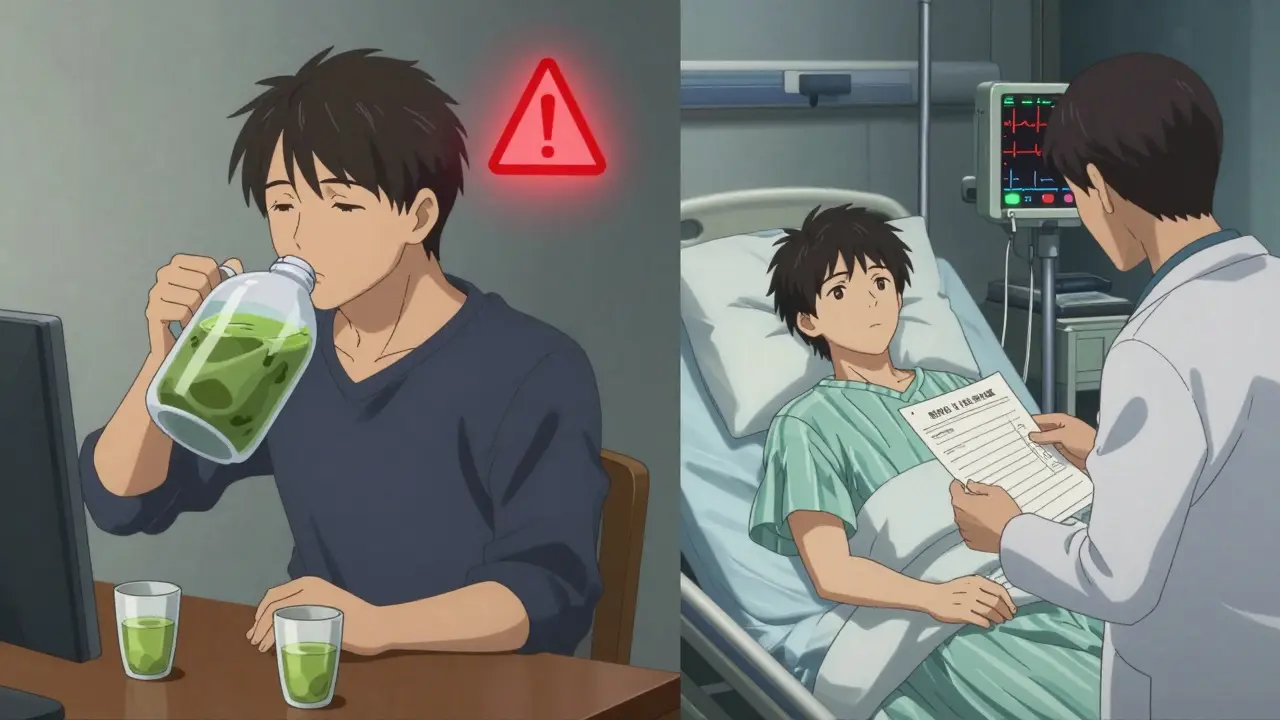
Because quantity matters. If you drink one cup a day - 8 ounces - you’re getting less than 0.1 micrograms of vitamin K. That’s less than 1% of your daily need. No effect. But if you drink a gallon a day? That’s 3,785 grams of tea. Multiply that by 0.03 micrograms per 100 grams? You’re getting nearly 1.1 micrograms of vitamin K. Not a lot? Maybe. But for someone on warfarin, that’s enough to fight the drug’s effect. There’s a documented case of a man whose INR crashed from 3.79 to 1.37 after drinking half to a full gallon of green tea daily. He needed a warfarin dose increase just to stay in range.
Matcha Is a Different Story
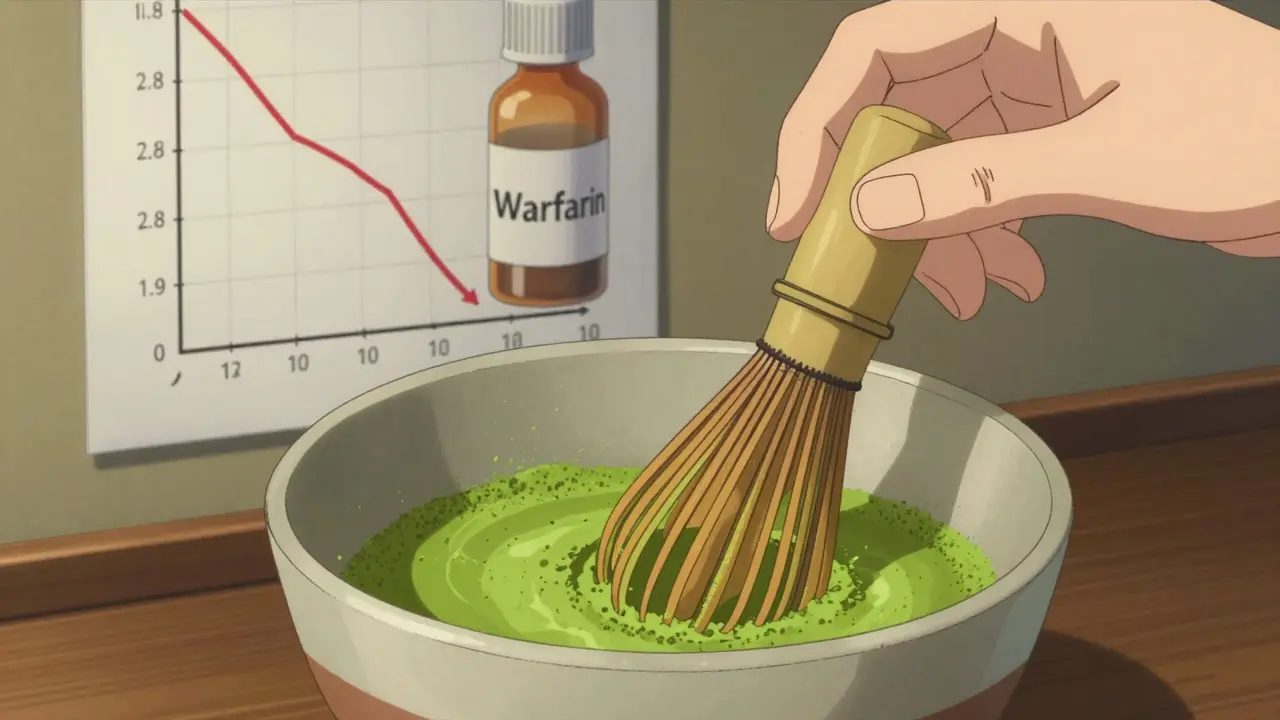
Regular green tea is steeped. You throw away the leaves. Matcha? You eat them. The whole leaf is ground into powder and whisked into water. That means you’re consuming every bit of vitamin K in the leaf. Matcha can have 10 to 20 times more vitamin K than brewed green tea. One study found that patients switching to matcha saw their INR drop by 30% within two weeks. One Reddit user, who drank four cups of matcha daily, saw his INR fall from 2.8 to 1.9. His doctor had to bump his warfarin dose by 15%. That’s not rare. Clinics report it often.
It’s Not Just Vitamin K - There’s a Paradox
Green tea isn’t just about vitamin K. It also contains catechins - antioxidants that may actually slow blood clotting by blocking platelet activity. So why don’t these two effects cancel each other out? Because they don’t work the same way. Vitamin K works in the liver, helping your body make clotting proteins. Catechins work in your blood, stopping platelets from sticking together. One boosts clotting. The other slows it. The net effect? It depends on how much you drink, how often, and your body’s chemistry. For most people drinking 1-3 cups of regular green tea, the vitamin K effect is too small to matter. But if you’re drinking more, or switching to matcha, the vitamin K wins.
How Much Is Safe? The Real Numbers
Here’s what the experts actually say - not vague advice like “drink in moderation.”
- Up to 3 cups (720 mL) of regular brewed green tea per day: No dose change needed. Stable INR expected.
- Between 721 mL and 1,500 mL per day: Monitor INR every two weeks. Your doctor may need to adjust your dose.
- More than 1,500 mL per day (over 6 cups): You’re at high risk. Expect to increase your warfarin dose by 10-15%. Don’t wait for an INR crash.
And if you’re switching from no green tea to 3 cups a day? Don’t panic. Just tell your doctor. They’ll check your INR in a week or two. If it’s stable, you’re fine. The real danger isn’t drinking green tea. It’s changing how much you drink without telling anyone.
What About Other Teas and Herbs?
Not all teas are equal. Black tea is similar to green tea in vitamin K content - low in brewed form. Herbal teas? Different story. Ginkgo biloba? Increases bleeding risk. Goji berry tea? One case report showed dangerous bleeding in someone on warfarin. Cranberry juice? That one consistently raises INR by interfering with how your liver breaks down warfarin. Unlike green tea, cranberry juice has a direct drug interaction - not just a vitamin K one.
And don’t assume “natural” means safe. The FDA doesn’t regulate herbal products like it does drugs. A bag of green tea from one brand might have 50% more vitamin K than another. Growing conditions, soil, processing - all of it changes the amount. That’s why consistency matters more than avoiding it.
What Should You Do?
Step one: Don’t panic. If you’ve been drinking one or two cups of green tea daily for years and your INR is stable? Keep doing it. Just don’t suddenly double your intake.
Step two: Track it. Write down how much green tea you drink - in milliliters, not cups. A cup is 240 mL. Four cups = 960 mL. Five cups = 1,200 mL. Know your numbers.
Step three: Talk to your doctor or anticoagulation clinic. Don’t wait for an INR spike. Tell them you drink green tea. Ask: “Should I be monitoring this?” If you’re on matcha, say so. If you drink more than 500 mL a day, ask for a biweekly INR check.
Step four: If you want to quit green tea? Don’t just stop. Tell your doctor. Your INR could rise suddenly. One woman stopped drinking black tea and her INR jumped from 1.7 to 5.0 in a week. That’s a bleeding emergency.
Why This Matters More Than You Think
Over 2.5 million Americans take warfarin. About 28 million drink green tea. That’s a lot of overlap. In 2022, the National Blood Clot Alliance found that 62% of warfarin users didn’t know green tea could affect their INR until they had a problem. Another 38% avoided green tea completely - even though they loved it - because they were scared. That’s unnecessary. You don’t have to give up tea. You just have to be smart about it.
And here’s the good news: mobile apps like WarfarinWise now let you log your tea intake. In a 2023 pilot study, users who tracked their green tea consumption saw a 22% drop in INR instability. Simple tracking saves lives.
Bottom Line
Green tea and warfarin can coexist - but only if you’re consistent. One or two cups a day? Fine. Matcha every morning? Tell your doctor. A gallon a day? You’re playing with fire. Your INR isn’t just a number. It’s your safety net. Don’t let a cup of tea pull it out from under you.


12 Comments
Just started drinking green tea last month and I’ve been keeping a little log in my phone-2 cups a day, no matcha, no crazy amounts. My INR’s been steady at 2.9 for 6 weeks now. I told my anticoagulation nurse and she gave me a thumbs up 😊
It is a matter of considerable scientific interest that the vitamin K content of brewed green tea is so negligible as to be pharmacologically inert, yet clinical case reports persistently associate excessive consumption with INR instability. One must question whether this is attributable to confounding variables or to a yet-uncharacterized pharmacokinetic interaction.
Man, I love how this post doesn’t just scare you-it gives you the tools to thrive. Green tea isn’t the enemy. Ignorance is. I’ve got my grandma on warfarin sipping her daily cup like it’s a ritual, and she’s been stable for three years. She even made me a little chart: ‘Tea: 2 cups. Spinach: 1x/week. No surprises.’ That’s the vibe. Consistency is the secret sauce 🌿
So let me get this straight-you’re telling me drinking a gallon of tea is dangerous, but eating a whole head of kale is fine? That’s not science, that’s cherry-picking data to scare people into compliance. Next you’ll say sunlight causes vitamin D overdose. Wake up.
As a pharmacist from India, I have seen many patients on warfarin who consume green tea daily without issue. The key is consistency-not avoidance. In our clinics, we advise: track intake, report changes, and do not fear the leaf. Nature does not intend harm; fear does. 🙏
Matcha is my morning ritual 😊 I switched from brewed tea to matcha last year. My INR dropped from 3.1 to 2.0 in 10 days. Told my doc, he upped my dose by 12%. Now I’m stable. No drama. Just facts. Tea is life. Knowledge is power. 🍵💪
Oh wow, so if I drink 3 cups of green tea and my INR drops, it’s because of vitamin K? But if I drink 3 cups of black tea, same thing-no problem? Funny how the article conveniently ignores that black tea has nearly identical vitamin K content. Classic misinformation dressed as medical advice.
bro i drink like 5 cups a day and my inr is 2.5??? why is everyone acting like its a bomb? i dont even know what vitamin k is
Interesting how this article frames green tea as the villain while ignoring that many patients on warfarin consume high-vitamin K supplements without disclosure. The real issue isn’t tea-it’s noncompliance with INR monitoring. Blaming tea is lazy.
Pharmacokinetic variability in tea catechin content is underappreciated. The CYP450 modulation potential of epigallocatechin gallate (EGCG) may exert a minor inhibitory effect on warfarin metabolism, particularly in slow metabolizers. However, the clinical significance remains negligible unless intake exceeds 1.5L/day, as the original study suggests. Consistency remains paramount.
Green tea? More like green propaganda. Big Pharma doesn’t want you to know tea is a natural anticoagulant. They profit off warfarin. Matcha is a detox miracle. Your INR drops because your body is healing. They call it ‘dangerous’-I call it ‘working.’ 🤫🍵 #FreeTheLeaf
Kenji, you’re not alone. I asked my doc the same thing. He said, ‘If your INR’s stable, keep doing what you’re doing. But if you change your intake-tell me.’ That’s all it is. Not fear. Just communication. 😊
Write a comment